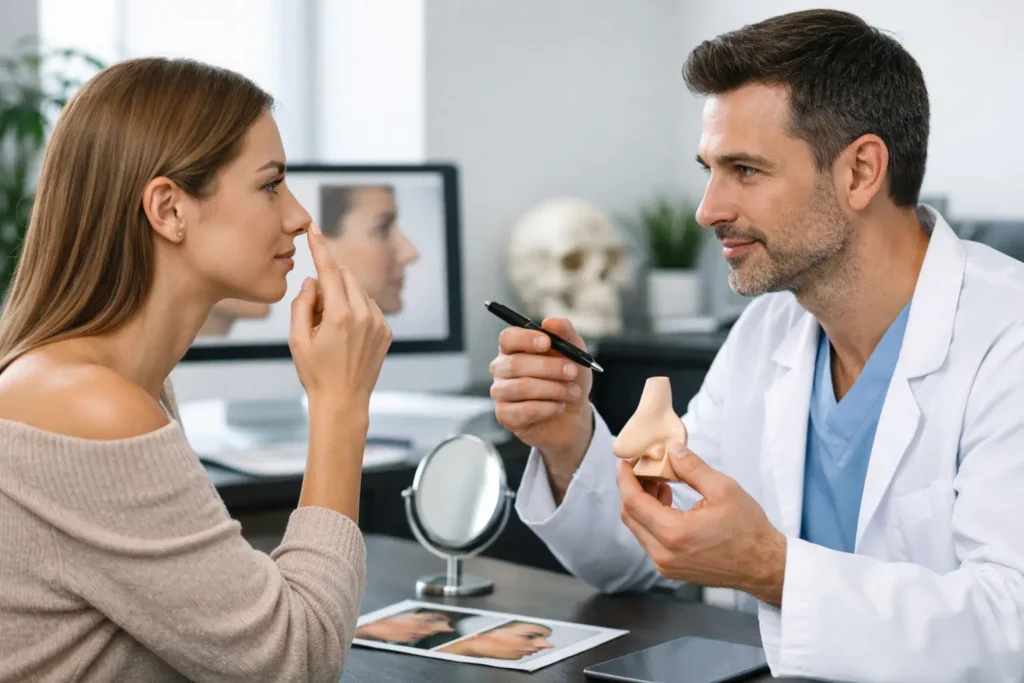
Digital simulation before rhinoplasty helps answer a question that is more important than “How will my nose look?” The real question is how well the planned change will harmonize with your facial character, skin structure, and breathing function. Digital simulation before rhinoplasty is a valuable planning tool that makes this question more concrete before surgery.
When used correctly, simulation does not offer the patient a ready-made nose model. Instead, it creates a shared aesthetic language between surgeon and patient. It provides a qualified basis for discussing how the slope of the nasal bridge, the rotation of the nasal tip, nasal width, or balance of the facial profile may change.
What is the real value of digital simulation?
Digital simulation is controlled visual planning performed on facial photographs taken under standard lighting and angles. Images from the front, both profiles, and three-quarter views help evaluate the relationship between the nose and the rest of the face. The goal is not simply to make the nose smaller or thinner. The aim is a balanced, natural result that belongs to the person’s face and harmonizes with the chin, lips, forehead, and eye area.
For example, a hump that appears prominent in profile is not reduced by the same amount in every patient. In some faces, an overly straight nasal bridge can weaken natural expression; in others, even a small correction can create a calmer and more balanced profile. Similarly, lifting the nasal tip too much may look impressive at first in a photo but can create an artificial expression in the long term.
Digital planning makes these nuances visible. The patient can move beyond a general request such as “a smaller nose” and better evaluate which change is meaningful for their own face. For the surgeon, it provides a strong reference for comparing aesthetic goals with anatomical realities.
How is digital simulation before rhinoplasty performed?
The simulation process does not replace a good examination; it accompanies it. First, the thickness of the nasal skin, cartilage strength, bone structure, nasal tip support, asymmetries, and previous operations are evaluated. Then, factors that affect breathing quality, such as septal deviation, turbinate enlargement, valve narrowing, or trauma-related deformities, are examined.
Photographs become meaningful after this clinical evaluation. The surgeon digitally shows changes that can be achieved without disrupting the natural proportions of the face. Possibilities such as softening the hump, refining the nasal tip, balancing nasal base width, or bringing deviation closer to the midline are discussed from different angles.
Looking at the whole face instead of a single image
Making a decision based only on the profile photo is not enough. A nose that looks elegant in profile may not necessarily be harmonious with the face from the front. Nasal tip width, nostril visibility, midface balance, and asymmetries become more obvious in the frontal view.
For this reason, a qualified simulation evaluates the face as a whole rather than in separate parts. The goal is not to imitate the uniform nose shape often seen on social media, but to preserve the person’s facial expressions, proportions, and ethnic characteristics while creating an individual aesthetic balance.
Is simulation a guarantee of the surgical result?
No. Digital simulation is not a promise or guarantee of the outcome. The surgical result is affected by swelling during recovery, skin thickness, tissue healing capacity, and the existing anatomy of the nose.
Especially in thick-skinned noses, refinement of the nasal tip may take longer to become visible. In thin-skinned patients, even the smallest structural irregularities can be more apparent. In patients who have previously undergone rhinoplasty, scar tissue, cartilage deficiency, and the skin-tissue relationship can make planning more complex. In revision rhinoplasty, simulation is even more valuable for setting expectations correctly, but it does not remove the limits created by previous surgery.
Therefore, an experienced surgeon does not present the simulated image as a definite postoperative photograph. The right approach is to clearly define the visual goal while honestly sharing the limits of what is achievable. In a high-standard consultation, trust comes not from exaggerated promises, but from this transparency.
Aesthetic goals and breathing function should be planned together
Rhinoplasty is not only a procedure that changes the external appearance. Narrowing the nasal bridge, shaping the nasal tip, or repositioning the bony structure can affect airflow. Therefore, aesthetic goals should not be considered separately from functional evaluation.
Some patients have long-standing nasal obstruction, sleeping with the mouth open at night, difficulty breathing during exercise, or one-sided airflow complaints. If there is septal deviation, internal nasal valve narrowing, or external valve weakness, a plan focused only on improving appearance may not be sufficient.
Digital simulation plays a communicative role here. How much can the nose be narrowed, to what degree can the nasal tip be refined, and how can these changes be balanced with airway support? These questions must be evaluated together with examination findings and surgical technique. When necessary, structure rhinoplasty, preservation rhinoplasty, or a hybrid use of both approaches may be selected to balance aesthetic refinement and structural safety. The suitable technique depends not on trends, but on nasal anatomy.
Which expectations are healthy in simulation?
A healthy expectation is wanting a more balanced version of your own face. Sharing another person’s nose photo as inspiration can make the consultation easier, but the same nose cannot create the same result on every face. Skin quality, bone-cartilage structure, nasal length, and overall facial proportions directly affect the result.
In a simulation consultation, the question “What do I like most in this image?” is more useful than “Can we make the exact same one?” Perhaps the appealing feature is a softer profile line, a more defined nasal tip, or a more balanced facial appearance. The surgeon analyzes this aesthetic preference and creates a personalized and feasible plan.
For patients seeking a natural result, small differences matter greatly. A few millimeters of projection change in the nasal tip, a controlled transition on the nasal bridge, or balancing a slight asymmetry can create a more refined appearance without changing the facial expression. Good rhinoplasty is often the kind that does not look “operated” at first glance.
How should you prepare for the consultation?
It is useful to bring not only your aesthetic wishes, but also your functional complaints to the consultation. Share previous trauma, past nasal surgeries, allergy history, medications you use, and any breathing problems during sleep. These details matter for the safety of the plan and the selection of the technique.
Also think about your daily life. Your desire for a quick social return, intense sports routine, stage or camera-facing profession, or international travel plans may affect the timing of recovery. Digital simulation does not replace these decisions, but it helps you evaluate more consciously what you are investing time and effort in.
In a boutique Adana-centered approach, the value of consultation is much broader than a single digital edit on a photograph. When facial analysis, breathing evaluation, surgical experience, and the patient’s aesthetic perspective meet at the same table, the plan becomes safer, more selective, and more personal.
The right simulation does not promise you another face. It helps you see the balance in your own face more clearly; and that is often exactly what you are looking for when making the decision.