
Preservation Rhinoplasty: A Conservative Approach and Artistic Touch in Modern Nasal Surgery
Nose aesthetics is the field where the scientific depth of surgery and the aesthetic vision of art intersect at the highest level. While traditional rhinoplasty methods have yielded successful results for decades, modern surgery has now evolved towards a less invasive, more tissue-friendly, and “naturalness-preserving” direction. The pinnacle of this evolution is the Preservation Rhinoplasty technique.
This method, applied by Op. Dr. Ergün Kürün at his clinic in Adana with over 30 years of experience, is based on the philosophy of “shaping existing beauty while preserving it” rather than “demolishing and rebuilding.”
What is Preservation Rhinoplasty?
PHILOSOPHY AND ANATOMICAL FOUNDATIONS
Preservation Rhinoplasty, in its simplest definition, is an advanced surgical technique that aims to correct the nasal hump and shape without disturbing the natural anatomical integrity of the nasal dorsum. While in traditional methods, the excess in the nasal hump is removed by cutting and excising cartilage and bone tissues (resection), in conservative surgery, the nasal roof is preserved as a whole.
Why is Tissue Preservation Important?
The dorsum of the human nose is a critical junction, known as the “K-area,” where breathing function and aesthetic lines converge. Preserving the skin, connective tissue, and cartilages in this region minimizes irregularities, risks of collapse, and the “operated nose” appearance that may occur on the nasal dorsum after surgery. In this technique, Dr. Ergün Kürün primarily focuses on “reducing” the entire structure downwards (Let-down or Push-down) by removing tissue from the lower part of the nose (septum).
Golden Standards of Conservative Surgery:
Let-Down and Push-Down TECHNIQUES
Preservation Rhinoplasty is an umbrella term that encompasses different application methods. The choice of these techniques is individually planned by Dr. Kürün based on the patient’s bone structure, skin thickness, and breathing problems.
1. Let-Down Technique
This is generally preferred for patients with a larger hump structure but a smooth nasal dorsum line (dorsal aesthetic lines). In this method, a strip of bone is removed from the lower parts of the nasal roof, and the nasal dorsum is lowered as a whole. This preserves the natural, smooth transition of the nasal dorsum.
2. Push-Down Technique
In cases where the nasal hump is relatively smaller, the principle is to free only the supporting structures and “push down” the nose without removing tissue. This method allows for the repositioning of anatomical structures without displacement.
Differences between Preservation Rhinoplasty
and Traditional Methods
Understanding the differences between Traditional (Structural) Rhinoplasty and Preservation Rhinoplasty is the most crucial step in the patient’s decision-making process.
Tissue Integrity:
In the traditional method, the nasal roof is opened and rebuilt. In the conservative method, the roof is never opened.
Recovery Process:
Since soft tissues and neurovascular structures are preserved in conservative surgery, the risk of bruising and swelling after the operation is much lower.
Naturalness:
Since the skin and cartilage transition on the nasal dorsum are not disturbed, the nose reflects light naturally; a “sharp and artificial” dorsal line does not form.
Revision Need:
Since structural integrity is preserved, the risk of collapse or asymmetry on the nasal dorsum in the long term is lower compared to structural surgery.
Nose Tip Aesthetics and Cartilage Preservation Approach
Preservation Rhinoplasty is not limited to the nasal dorsum. A “conservative” approach is also adopted in shaping the nasal tip. Instead of cutting and removing nasal tip cartilages, Op. Dr. Ergün Kürün creates a dynamic nasal tip with special suturing techniques and maneuvers that reshape the cartilages.
Thanks to this approach, nasal tips are achieved that do not droop over time, move naturally when smiling, do not appear “pinched,” and add character to the face.

Recovery Process and Patient Comfort
The greatest promise of modern technology and conservative surgery is to return the patient to social life as quickly as possible. Patients who undergo Preservation Rhinoplasty can usually return to their work or education life on the 7th day after the operation.
First 48 Hours: Minimal Swelling
Since tissue damage is minimal, severe bruising around the eyes is not observed in the vast majority of patients. With ice application and the special care protocol prescribed by Dr. Kürün, this process is quite comfortable.
First Week: Removal of Splints and Silicone
Unlike traditional fears, modern silicone splints do not obstruct breathing and do not cause pain when removed. When the protective splints on the nose are removed at the end of the first week, the main contour of the nose begins to emerge.
Result: Perfect Balance of Function and Aesthetics
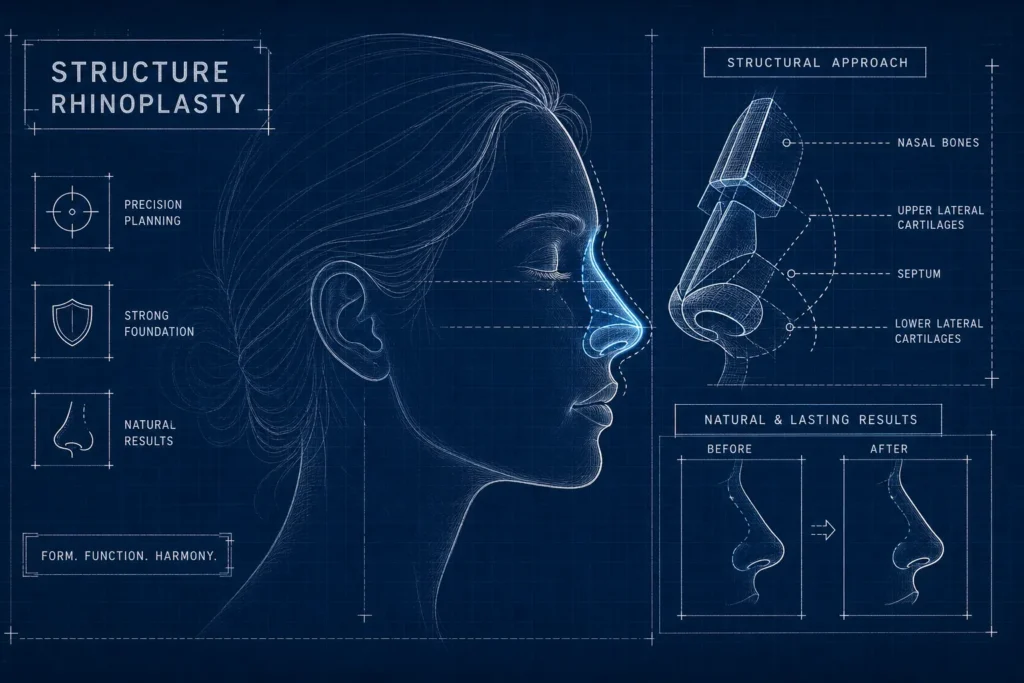
Preservation Rhinoplasty is the most advanced point reached in nose aesthetics. However, this technique may not be suitable for every patient. Especially in very traumatic, previously operated (revision), or severely crooked noses, hybrid methods with “Structure Rhinoplasty” may be necessary.
From the first examination, Op. Dr. Ergün Kürün offers his patients the most honest and scientific approach, detailing which technique will yield the “safest and most aesthetic” result for that individual. It should be remembered that the best nose is the one that is least noticeable on its owner’s face, but enhances life with its breathing quality.
Why Op. Dr. Ergün Kürün and
Conservative Surgery?
Rhinoplasty surgery is not merely a technical procedure but a combination of the surgeon’s “case experience” and “artistic vision.” Throughout his 30-year professional career, Dr. Ergün Kürün has examined thousands of different anatomical structures and modernized these techniques for his patients in Adana by personally following conservative surgery congresses worldwide.
Personalized Planning (Customized Planning)
Every nose is unique. When applying Preservation Rhinoplasty techniques, Dr. Kürün does not merely look at the patient’s photograph; he analyzes skin thickness, cartilage resistance, and the golden ratio of the face. His aim is to design a nose that, when viewed from the outside, does not appear as an “aesthetically operated nose,” but rather a “nose that looks like it has always been yours, integrated with your face.”
Frequently Asked
Questions
PRESERVATION RHINOPLASTY
1. Is Preservation Rhinoplasty suitable for every nose structure?
The Preservation technique is ideal, especially for patients with a smooth nasal dorsum line who are undergoing surgery for the first time. However, in cases with a history of severe trauma, previous surgery (revision), or a very irregular nasal roof, Dr. Ergün Kürün may sometimes prefer a hybrid approach with the “Structure” technique. The most accurate decision is made after a detailed endoscopic examination and anatomical analysis.
2. Does nasal tip droop occur with the Preservation Rhinoplasty method?
On the contrary, in Preservation Rhinoplasty, instead of cutting and weakening the nasal tip cartilages, these structures are reshaped and supported with special suturing techniques. Since the natural ligaments are preserved, the nasal tip gains dynamic flexibility and remains much more resistant to potential drooping over time compared to traditional methods.
3. How long does the post-operative recovery process take, and will there be bruising?
In conservative surgery, the vascular and nerve structures (SMAS layer) directly beneath the skin are preserved. This minimizes tissue damage. In the vast majority of our patients, bruising either does not occur at all or remains very mild. Generally, the protective splints on the nose are removed on the 7th day, and our patients can comfortably return to their social lives.
4. Is bone breaking performed in the Preservation technique?
While in the traditional method, bones are intervened by cutting/breaking them from above, in the Preservation technique, thin lines are removed from the bone base using “Let-down” or “Push-down” methods. This allows the upper (dorsal) part of the nasal bone to be lowered as a whole without breaking. This prevents irregularities that might be felt on the nasal dorsum and the appearance of an “operated nose.”
5. Can breathing problems be resolved with this technique?
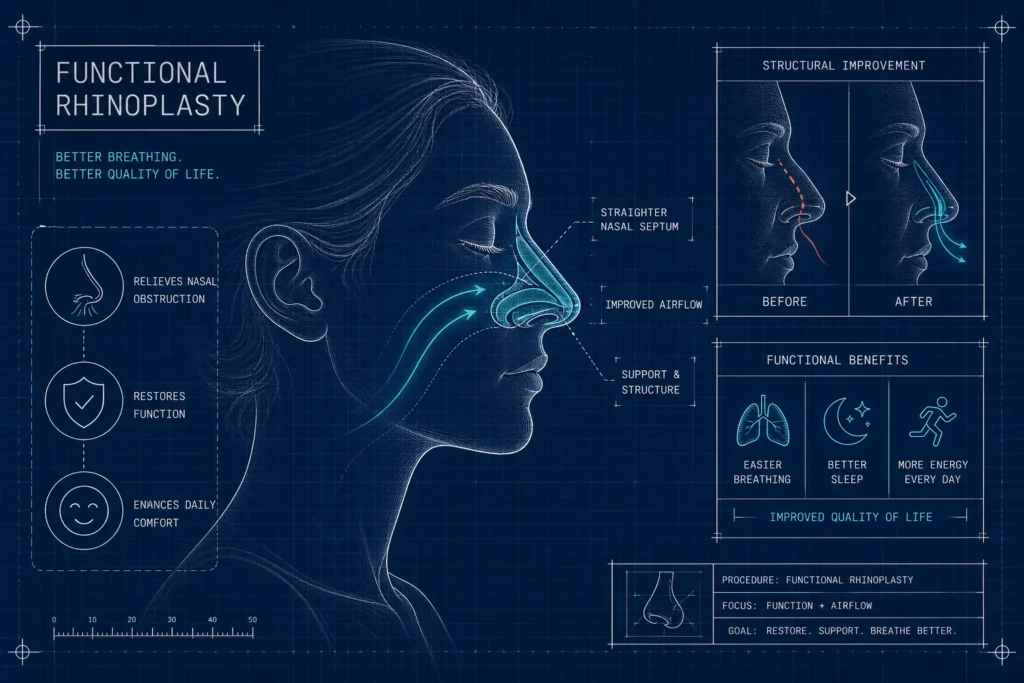
Yes. Preservation Rhinoplasty is not only an aesthetic procedure but also a functional surgery. Intranasal curvatures (deviation) and concha (turbinate) enlargements that obstruct the airway are treated simultaneously during the conservative technique. Since the nasal roof is preserved, the middle vault valve mechanism is not damaged, and a better quality airway is provided after surgery.