
Structure Rhinoplasty: Functional and Aesthetic Architecture
Considered the “gold standard” in the world of nose aesthetics, Structure Rhinoplasty is not merely a change in shape but a comprehensive engineering approach that reconstructs the internal architecture of the nose. Unlike Preservation surgery, structural rhinoplasty aims to create an “unshakeable foundation” in cases where the cartilage and bone support of the nose are weak, severe deviations are present, or previous unsuccessful operations have occurred.
As Op. Dr. Ergün Kürün, in this core content, we will examine in detail the scientific depth of structural rhinoplasty, its application methodology, and why this technique forms the backbone of modern nasal surgery.
What is Structure Rhinoplasty?
Core Philosophy and Approach
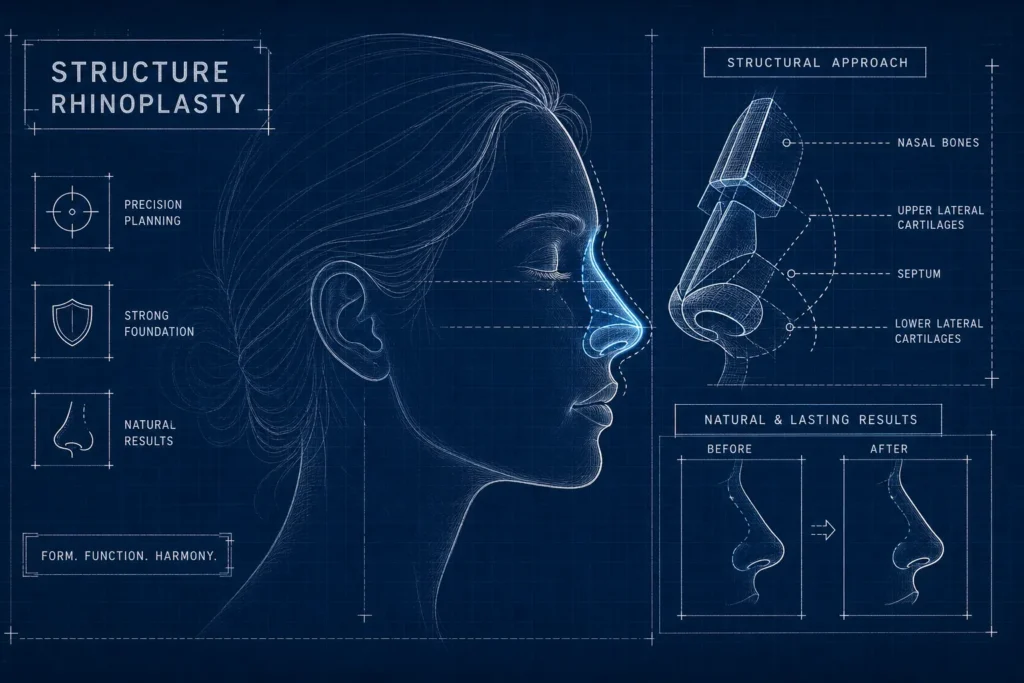
Structural rhinoplasty is a technique that uses cartilage grafts (supports) to increase the support of the nasal tip and dorsum. The fundamental philosophy of this method is not merely to reduce nasal tissue but to strategically strengthen it.
Why is it Called “Structural”?
In traditional rhinoplasty methods, cartilage tissue is often removed, and the nose is reduced. However, this can lead to the collapse of the nasal bridge or drooping of the nasal tip in the long term. Structural rhinoplasty, on the other hand:
Uses the Septum cartilage inside the nose like a column.
Reinforces weak areas with the patient’s own cartilage (autologous grafts).
Ensures the nose remains resistant to gravity and aging for a lifetime.
Advantages and Indications of Structural Rhinoplasty
Advantages and Indications
Each patient’s nasal anatomy is different. Structural rhinoplasty stands out for the control it offers the surgeon, especially in complex cases.
Functional Success: A Breathable Nose
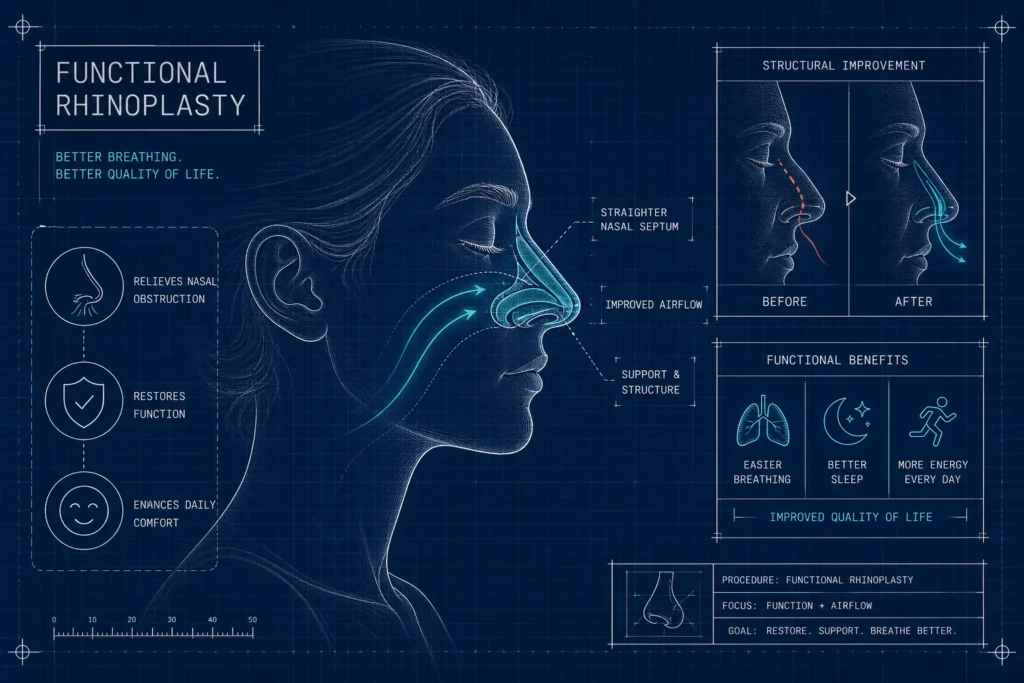
No matter how aesthetic a nose may be, if its breathing function is impaired, the operation is considered unsuccessful. The Structure technique expands the breathing passages, known as “Internal and External Valves,” ensuring the patient has maximum airflow after the operation.
Aesthetic Durability: No More Nasal Tip Drooping
The “nasal tip drooping,” which is the biggest fear of many patients, is made impossible with techniques used in structural rhinoplasty such as Septal Extension Graft or Columellar Strut. The nasal tip is fixed at an angle appropriate to the dynamics of the face.
Who Is It Ideal For?
Noses with severe deviation (axis deviation).
Patients with thick skin and weak cartilage support.
Those experiencing severe airway obstruction.
Revision patients who have undergone previous operations and experienced tissue loss.
Operation Process:
Step-by-Step Structural Construction
Structural rhinoplasty is a process where the surgeon’s artistic vision and anatomical knowledge combine at the highest level.
1. Planning and Analysis
In digital analyses performed before the operation, not only the external appearance of the nose but also the resistance of its internal cartilage structure is measured. In our clinic in Adana, this stage constitutes 50% of the operation.
2. Determination of Cartilage Source
Grafts are necessary for structural construction. These grafts are usually obtained from the following areas, respectively:
Inside the Nose (Septum): This is the first choice and the highest quality cartilage source.
Ear Cartilage: If there is insufficient tissue in the septum, ear cartilage, which has flexibility suitable for the nasal form, is preferred.
Rib Cartilage: Especially in severe revision cases, it is the strongest source used when robust and abundant grafts are needed.
3. Application of Advanced Surgical Techniques
During the operation, cartilages are placed with millimeter precision, like building blocks. At this stage, the nasal bridge is reconstructed using suturing techniques and grafting methods.
Structure vs. Preservation
WHICH TECHNIQUE IS RIGHT FOR YOU?
In our clinic, we successfully apply both techniques (Preservation and Structure). However, the most common question patients ask is: “Which technique is better?”
Different Needs, Different Solutions
Preservation Rhinoplasty: Preferred for “suitable” noses with a natural nasal dorsum, high cartilage quality, and no need for radical changes.
Structure Rhinoplasty: Unrivaled in cases where the nose needs to be completely redesigned, increased support is mandatory, and functional problems are prominent.
The Role of Structure Technique
in Revision Rhinoplasty
Correcting previously failed operations (Secondary Rhinoplasty) is one of the most challenging areas of surgery. Structural rhinoplasty acts as a “savior” at this point.
Replacement of Lost Tissues
“Saddle nose” or “pinched nose” deformities resulting from excessive cartilage removal in the first surgery can only be corrected with structural grafting. The aim in this process is not only to correct the nose but also to renew its tissue memory.
Recovery Process and Post-Operative Care
Structural rhinoplasty requires more manipulation of the tissue, so the recovery process demands patience. However, the results are much more predictable.
Recovery Timeline: From the First Week to One Year
First 7 Days: Splint and silicone tampons are removed. During this period, the nose maintains its form thanks to structural supports.
First 3 Months: 70% of the edema subsides. The integration of structural cartilages with the skin begins.
Year 1: The nose achieves its final shape. The greatest advantage of the structural technique becomes evident during this period: the nasal tip remains firm and maintains its angle, just as it was on the first day.
Structural Rhinoplasty Experience
with Op. Dr. Ergün Kürün
When it comes to nose aesthetics in Adana, we combine our quarter-century of experience with modern structural rhinoplasty techniques. We evaluate each patient with the meticulousness of an architect, designing noses that breathe healthily and maintain their form not only for today but also for 20-30 years to come.
Scientific Approach, Artistic Results
The Structure technique we apply in our clinic is not an aesthetic illusion but a real tissue repair. Our goal is to build a natural-looking and unshakeable profile that respects the character of your face.
Conclusion: The Future of Nasal Surgery
Structure Rhinoplasty is the most concrete and durable answer modern medicine provides to aesthetic concerns. If you are looking for both visual and functional excellence in your nose, you should prefer a structural transformation instead of temporary solutions.
FREQUENTLY ASKED
QUESTIONS
STRUCTURE RHINOPLASTY
1. Does nasal tip drooping occur after structural rhinoplasty?
No. This is the most fundamental goal of structural rhinoplasty (Structure). During the operation, the nasal tip is fixed like an architectural column with cartilage supports called “Septal Extension.” This ensures that the nasal tip does not droop due to gravity or time; the angle designed on the day of the operation is maintained for a lifetime.
2. Is it absolutely necessary to take cartilage from the rib in this technique?
Not always. In our primary patients undergoing surgery for the first time, the patient’s own cartilage inside the nose (septum) is usually sufficient for structural construction. However, in “Revision” patients who have undergone previous operations and whose internal nasal cartilage is depleted, we may resort to rib or ear cartilage to establish a robust structure.
3. Will the nose be very hard after structural rhinoplasty?
In the first months of the recovery period, the nasal tip may feel harder than normal due to the placed support cartilages and edema. However, from the 6th month onwards, the tissues soften, and the nasal tip regains its natural flexibility. The nose becomes a “resilient” rather than a “hard” structure.
4. Is this technique only suitable for problematic or crooked noses?
Structural rhinoplasty can be applied to all types of nasal structures. It is the safest method, especially for increasing the definition of the nasal tip in patients with thick skin or preventing collapse in individuals with very weak cartilage support. Dr. Ergün Kürün decides which technique will yield the best results based on the patient’s anatomy during the analysis phase.
5. Is the recovery period longer in structural rhinoplasty?
Since the structural technique requires more detailed work on the tissue, the amount of edema observed in the first week may be slightly higher compared to preservation techniques. However, thanks to the “Piezo” (ultrasonic) methods used, bruising is minimal. You can usually return to your social life within 7-10 days; the full recovery process is similar to other techniques.