You start researching nose surgery, and within an hour you have two terms circling in your head: structure rhinoplasty and preservation rhinoplasty. Both sound technical. Neither explanation tells you which one actually applies to your nose. That gap in clarity is exactly what this article closes.
Structural rhinoplasty is not just another name for a nose job. It is a distinct surgical philosophy built on one core principle: when the nasal framework lacks sufficient support, you rebuild it rather than simply reduce it. The technique uses cartilage grafts to reinforce, reconstruct, and stabilize the nose so that the result holds its shape long-term, not just for the first few years. This article covers how it works, which grafts your surgeon will place and why, how it compares to preservation rhinoplasty, who genuinely needs it, what recovery looks like, and the specific questions you should bring to any consultation.
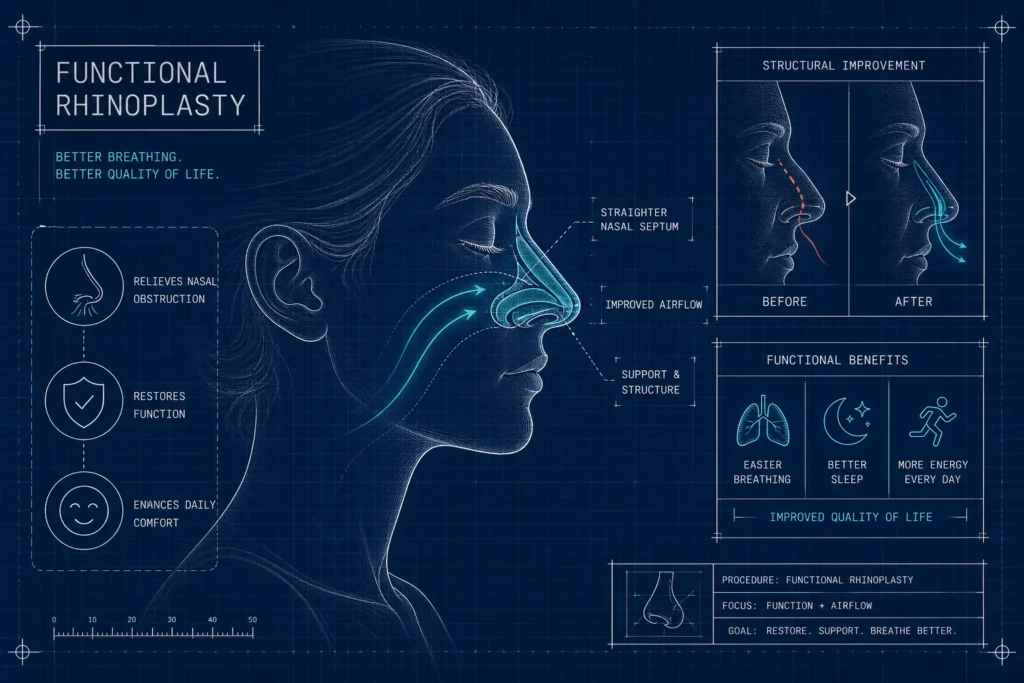
One important point before the technical detail: structural planning that ignores airway function can create new breathing problems even while fixing cosmetic ones. Some clinics approach structural rhinoplasty from both an ENT and an aesthetic framework simultaneously. Op. Dr. Ergün Kürün’s practice in Adana integrates that dual lens directly into the preoperative plan, combining functional airway evaluation with aesthetic assessment from the outset.
What structural rhinoplasty actually is
Structural rhinoplasty prioritizes adding support to the nasal framework rather than simply removing tissue. That single shift in philosophy separates it from the reductive rhinoplasty that dominated surgical practice for decades. Traditional approaches took bone and cartilage away from the top of the dorsum, often leaving the nose fragile and prone to collapse years later. Structural technique reconstructs what was removed, or reinforces what was already weak, so the nose holds its shape long-term.
Think of it as an architectural problem. Removing a dorsal hump without rebuilding the support underneath is like taking out a load-bearing wall without adding a replacement beam. The structural approach identifies where the nasal framework is insufficient, whether from genetics, trauma, or a previous surgery, and builds it back up using cartilage grafts before or during reshaping. The goal is a nose that is structurally more resilient after surgery than it was before, with support restored rather than further depleted.
Traditional rhinoplasty focused on reduction: shave the hump, refine the tip, narrow the width. Structure rhinoplasty prioritizes reconstruction alongside any reduction. The surgeon removes what needs to go, then reinforces the remaining skeleton with grafts so the result stays stable over time. This is why structural technique is the dominant approach in complex cases, revisions, and situations where the native cartilage is too weak or too depleted to hold shape on its own.
Specific clinical triggers make structural support medically necessary rather than merely preferred: revision rhinoplasty with depleted cartilage from a prior surgery, significant tip drooping or asymmetry, nasal valve collapse causing breathing obstruction, crooked noses with structural deviation, and ethnic rhinoplasty cases where thicker skin requires a stronger underlying framework to show definition. These are structural requirements, not cosmetic preferences.
The grafts and techniques that make it work
You don’t need a surgical manual, but you do need to understand what your surgeon is actually placing inside your nose and why each piece matters. The grafts used in structural rhinoplasty each solve a specific mechanical problem, and knowing what they are makes every consultation more productive. (For a deeper review of common grafting techniques and their characteristics.)
The columellar strut sits between the two lower cartilage legs of the nasal tip, acting like a vertical post that keeps the tip from drooping or rotating downward. Without it, tip projection can diminish within the first few years as the native cartilage weakens under the pull of scar tissue. Spreader grafts serve a different function: they sit between the septum and the upper lateral cartilages in the middle vault, widening the internal nasal valve, the narrowest point of the entire airway. They prevent the “inverted V” collapse that can appear years after aggressive reductive surgery and shows up as a visible pinching across the bridge. For technical approaches to tip and alar support, see practical discussions of nasal tip and alar structural support techniques.
The caudal extension graft extends the front edge of the septum, giving the surgeon direct control over how far the tip projects and how much it rotates. This graft is especially critical for short noses or overly-rotated tips. The shield graft, placed at the very tip, adds definition and projection to the infratip area, the part of the nose visible in profile below the domes. Together, these two grafts allow precise, reproducible tip positioning that holds over time.
Not every adjustment requires a new piece of cartilage. Suture techniques, specifically dome-binding and lateral crural mattress sutures, reshape existing cartilage by changing how structures are pulled and held together. These work alongside grafts to fine-tune tip symmetry and reduce bulbosity. A surgeon who combines well-chosen grafts with precise suture techniques can produce cleaner results with less added volume.
Cartilage source selection
Cartilage source matters too. Septal cartilage is the first choice in primary cases: it is straight, strong, and easy to sculpt. In revision cases where the septum has already been harvested, rib cartilage provides the volume and strength needed for major reconstruction. Ear cartilage, flexible and naturally curved, is reserved for softer, non-structural applications like alar rim grafts rather than primary support. For patient-oriented information about using rib cartilage in complex reconstructions, see resources on rib cartilage for rhinoplasty.
Structure rhinoplasty vs. preservation rhinoplasty: what actually changes
Both approaches are used by skilled surgeons and both can deliver strong results, but they solve different problems. The question is which problem the patient actually has.
Preservation rhinoplasty keeps the dorsal roof intact and lowers it by removing tissue from underneath rather than cutting the hump off the top and rebuilding. Because the native skin and ligament connections are maintained, the result tends to look more natural and recover faster. Dorsal preservation avoids the sharp edges and visible irregularities that can occur when the dorsum is reconstructed from scratch. It is a fundamentally different operation: less dissection, less scarring, less rebuilding. For a clear, patient-facing comparison of the two philosophies, see a practical overview of structural vs. preservation rhinoplasty.
The outcome differences that matter most to patients come down to two factors: complexity and recovery. Preservation delivers more natural-looking results and faster social recovery because less tissue is disturbed. Structural technique provides greater versatility and predictability for complex or severe cases where preservation simply cannot achieve the required change. Recovery after structural surgery is longer: most patients return to normal activities within 10 to 14 days, but final swelling resolution takes 9 to 12 months. Preservation patients often see their results settle faster with less bruising.
A growing number of surgeons are now combining both philosophies into what is called structural preservation rhinoplasty. This hybrid technique preserves the natural dorsal anatomy while using columellar struts and tip grafts to build a defined, stable nasal tip. For patients who have a modest hump and a weak or undefined tip, this combination delivers the natural dorsal appearance of preservation with the tip precision of structural technique.
Who is actually a good candidate for structure rhinoplasty
Structural rhinoplasty is the appropriate choice when the nose has compromised support that preservation alone cannot address. The clearest candidates include patients who have had a previous rhinoplasty that removed too much cartilage, patients with severe tip drooping or asymmetry, those with internal or external valve collapse causing chronic breathing obstruction, noses with structural deviation that cannot be corrected through surface reshaping alone, and cases requiring significant projection changes. Patients with thicker nasal skin also benefit because a stronger underlying framework is needed to show definition through the skin envelope.
This is where ENT expertise genuinely changes the surgical outcome, not just the marketing language. Structural rhinoplasty does more than reshape the nose: every graft placed and every suture applied affects airflow. A surgeon without ENT training may optimize for appearance while inadvertently narrowing the internal nasal valve or over-rotating the tip in ways that compromise breathing.
At Op. Dr. Ergün Kürün’s clinic, preoperative planning includes endoscopic nasal function evaluation, which maps the airway before a single incision is made. Spreader grafts are sized for function, not just aesthetics. Caudal extension grafts are placed using the septum’s true anatomical position as the baseline. That level of integration between form and function reflects ENT-rooted rhinoplasty at its most thorough.
Not everyone needs structural technique, and a good surgeon will tell you that directly. Patients with a small-to-moderate dorsal hump, intact tip support, good cartilage quality, and no prior nasal surgery are often better served by preservation rhinoplasty. Technique selection depends on a complete anatomical assessment, which is exactly why the consultation evaluation matters as much as the surgical plan itself.
Recovery timeline and functional outcomes after structure rhinoplasty
The nasal splint or cast stays on for seven to ten days. Bruising and swelling peak in the first 48 hours, then progressively improve. By day 10 to 14, most patients look presentable enough to return to desk work or video calls. A standard acute-care regimen, covering compression, elevation, and wound management, moves patients efficiently through the first week. Strenuous exercise is off the table for six to eight weeks; contact sports for at least three months. (If you need specific guidance about when it’s safe to fly after surgery, review recommendations in Flying Home After Rhinoplasty: What Surgeons Recommend, Adana Burun Estetiği.)
The maturation timeline is longer than most patients expect. At one month, roughly 67% of swelling has resolved. By six months, 95% is gone. Final tip definition is visible at nine to twelve months. Patients with thicker nasal skin may need up to eighteen months. This is not a sign that something went wrong; it is cartilage and tissue healing on their own schedule. Taking photos at three-month intervals helps you track progression and avoid the frustration of comparing too early.
Functional breathing improvements
For patients who had functional issues before surgery, breathing improvement is often one of the first changes they notice, even before the cosmetic result is fully visible. As internal swelling resolves over the first four to six weeks, airflow through the nasal valve improves steadily. Spreader grafts and corrected septal deviation produce structural changes: unlike decongestants or nasal strips, these corrections do not wear off. For patient-focused education on improving nasal airflow with rhinoplasty, see resources on rhinoplasty to breathe better. Rhinomanometry-based outcome data from functional rhinoplasty literature consistently documents decreased nasal resistance and increased airflow after septorhinoplasty, with benefits sustained at long-term follow-up.
Questions to ask your surgeon before choosing structural rhinoplasty
These questions give you a real framework for your consultation, and any experienced surgeon should answer them with specificity, not generalities.
- Technique and case volume: How many structural rhinoplasties do you perform per year, specifically in cases like mine? Can I see unedited before-and-after photos from patients with similar anatomy, including revision or ethnic cases? Structural rhinoplasty has a steep learning curve, and the quality of the grafting and suture work is only as good as the surgeon’s repetitions.
- Graft source and planning process: Where will the cartilage come from, and why? Does the surgical plan account for airway function, not just aesthetics? Do you use digital imaging or morphing software during planning, and how do you communicate projected outcomes?
- Recovery and revision policy: What is a realistic recovery timeline for my specific anatomy? What is your revision policy, and under what circumstances are corrections performed? What are the primary risks for my case: nasal valve narrowing, tip drooping over time, or visible graft edges through thin skin?
A surgeon who cannot explain graft selection, dismisses functional evaluation, or responds to risk questions with vague reassurances is not approaching this surgery with the full picture. The right surgeon walks through these scenarios with precision.
The decision that shapes everything else
Structure rhinoplasty is not a one-size-fits-all technique. For patients who need lasting tip stability, complex correction, or functional restoration alongside cosmetic refinement, it is the most versatile and reliable approach available. The technique works because it solves the root problem, insufficient nasal support, rather than papering over it.
The single most important decision in the entire process is choosing a surgeon who understands both the architectural and functional demands of structural technique. Op. Dr. Ergün Kürün brings an ENT-rooted approach to structural planning, with extensive experience in advanced techniques including open structure rhinoplasty, preservation rhinoplasty, and ultrasonic (Piezo) rhinoplasty, and a preoperative process built around both the airway and the aesthetic outcome simultaneously. If you want to read more about whether structural approaches give longer-lasting results, see Does structural rhinoplasty last longer than conventional?, Adana Burun Estetiği.
If you are evaluating whether structure rhinoplasty is the right fit for your anatomy, the next step is a thorough evaluation. That assessment, which includes endoscopic nasal function mapping and digital surgical planning, is where the right technique for your specific nose gets identified. Book a consultation with Dr. Kürün’s clinic and get a clear, anatomy-based answer rather than a generic recommendation.