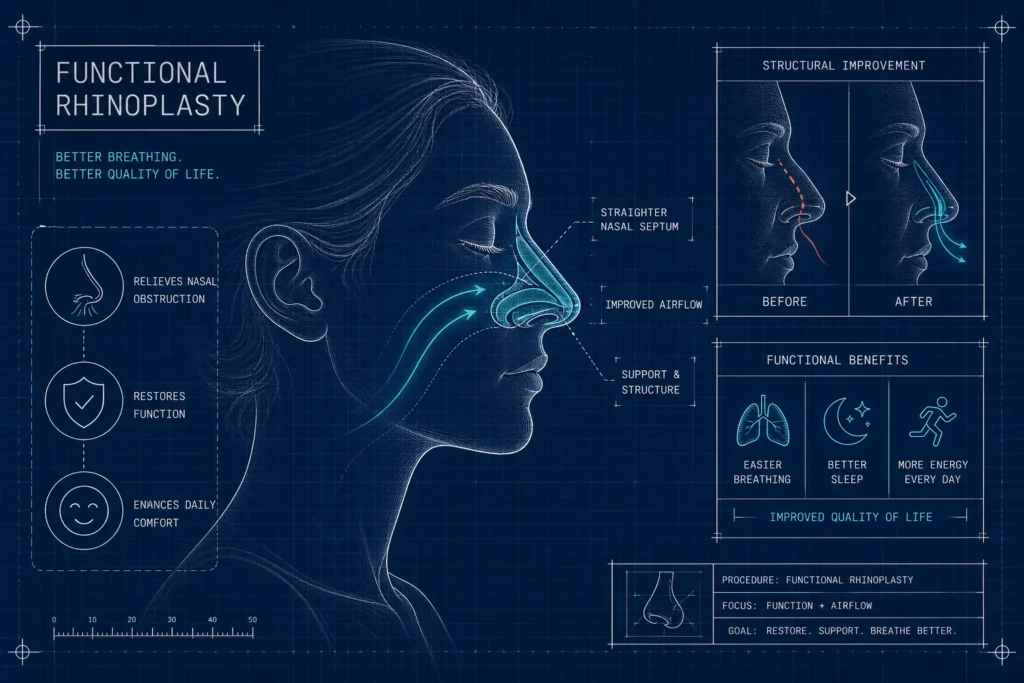
You’ve been told you have a deviated septum. You also want to change how your nose looks. The question almost every patient asks next is whether they can have septoplasty and rhinoplasty at the same time, fixing both problems in a single surgery, without two separate recoveries, two rounds of anesthesia, and twice the time off work.
The answer is yes. For most patients dealing with both functional and cosmetic concerns, the combined approach is not just acceptable. It’s often the better surgical decision. Medically, this procedure is called septorhinoplasty, and it’s widely regarded as the gold standard for patients who have a documented airway obstruction alongside cosmetic goals. What surgeons who specialize in both ENT function and nasal aesthetics have long understood is that the septum and the nose’s external shape are structurally linked. Correcting one without considering the other can produce suboptimal outcomes on both fronts.
This article covers everything you need to make an informed decision: who is a good candidate, the real benefits and risks, what recovery actually looks like week by week, how the combined approach affects your total cost, and the specific questions to bring into your surgical consultation.
Why Surgeons Often Recommend Combining These Two Procedures
Septoplasty and Rhinoplasty at the Same Time: When It’s the Smarter Surgical Choice
The clearest case for combining is when a patient has a deviated septum causing airway obstruction and also wants to reshape their bridge, tip, or overall nasal profile. These aren’t separate problems with separate solutions. In many cases, especially when nasal bones are crooked due to injury or congenital deviation, a cosmetic-only rhinoplasty that ignores the septal architecture leaves the patient with an improved appearance but persistent breathing problems. A structural problem left unaddressed doesn’t disappear; it often becomes more apparent as internal swelling resolves and the airway shifts.
Performing both procedures simultaneously allows the surgeon to approach the nose as a unified structure, balancing the internal airway against external form. The result is a more cohesive surgical plan and, in most cases, a better outcome for both function and aesthetics.
The Structural Advantage of Harvesting Septal Cartilage
This is one of the most important surgical reasons to combine the procedures, and it’s something many patients don’t hear about until they’re already in a consultation. During septoplasty, the surgeon removes and reshapes cartilage from the deviated septum. That harvested cartilage doesn’t go to waste, it becomes the primary grafting material used to reinforce the nasal bridge, tip, and sidewalls during the rhinoplasty portion of the procedure.
Using the patient’s own tissue, what surgeons call autologous grafting, produces more natural and durable results than synthetic implants. Autologous cartilage integrates with surrounding tissue, carries a low risk of rejection or infection, and maintains structural stability over time. At Op. Dr. Ergün Kürün’s clinic in Adana, cartilage grafting is central to the Preservation and Structure Rhinoplasty approach, where septal cartilage provides the foundation for long-lasting tip support and nasal framework stability. Synthetic alternatives are associated with higher rates of extrusion, infection, and eventual removal, outcomes that autologous septal cartilage carries a meaningfully lower risk of producing. Recent research on nasal grafting further supports the use of autologous cartilage for durable structural support.
Who Is (and Isn’t) a Candidate for Septorhinoplasty
The ideal candidate has documented septal deviation causing measurable breathing impairment and clear cosmetic goals for their nose. They are in good overall health and hold realistic expectations about what surgery can achieve.
Some patients should stage the procedures instead. If the combined operative time would exceed five to six hours, surgeons generally recommend separating the surgeries to avoid excessive physiological stress. Patients with complex revision histories that require detailed pre-surgical planning, or those with medical conditions that limit extended anesthesia exposure, are also better served by a staged approach. Active sinonasal infections, uncontrolled allergies, or autoimmune conditions like vasculitis are additional contraindications. If you’re unsure which category you fall into, a proper endoscopic nasal function evaluation alongside your cosmetic consultation will clarify the picture quickly.
The Real Benefits of Getting Both Done in a Single Operation
One Recovery Instead of Two: Why This Matters More Than It Sounds
Two separate surgeries mean two periods of downtime, two rounds of post-operative discomfort, two sets of restrictions on exercise and social activity, and twice the time away from work. Most patients don’t fully appreciate this until they calculate the numbers. A combined septorhinoplasty compresses all of that into one recovery window. Most patients return to desk work and resume social life within 10 to 14 days, compared to the cumulative two to four weeks of total downtime from two staged surgeries, with the required healing gap between them running six to twelve months.
Well-executed combined surgery, with thorough surgical planning and precise technique, can allow social recovery within seven to fourteen days for many patients. For those traveling internationally from the United States, compressing the entire procedure into one trip is a significant logistical advantage.
Septoplasty and Rhinoplasty Same Time: How Combining Saves You Money
The savings occur because you pay for one anesthesia event, one facility fee, one set of pre-operative tests, and one recovery period instead of two. Anesthesia alone typically runs $1,000 to $2,500 per session; facility and operating room fees add another $2,000 to $5,000 per session. Patients who combine procedures typically save 15 to 30 percent on total costs compared to staged surgeries. In the United States, the total out-of-pocket cost for septorhinoplasty runs approximately $11,700 to $20,000 depending on the surgeon, location, and complexity of the case.
For US patients evaluating options abroad, this cost advantage can extend further. Procedures at clinics like Op. Dr. Ergün Kürün’s in Turkey are often substantially less expensive than comparable US providers, a difference that, when combined with the single-trip logistics of a combined procedure, makes the overall cost picture worth examining carefully. If you want a detailed discussion comparing options, see Is Rhinoplasty in Turkey Worth It for American Patients? The exact savings vary depending on procedure complexity and the specific providers being compared.
Avoiding a Future Revision Caused by Ignored Structural Problems
A cosmetic-only rhinoplasty that doesn’t address an underlying septal deviation can cause or worsen breathing problems after surgery as internal swelling resolves and airway geometry changes. This is one of the most preventable causes of post-rhinoplasty dissatisfaction. The national rhinoplasty revision rate sits at approximately 10 to 15 percent; in published case series from high-volume centers, surgeons performing combined procedures under a structured surgical plan report revision rates well under one percent. Addressing structural problems simultaneously is one of the most effective ways to avoid a revision.
Risks and Complication Rates: What the Data Actually Shows
The Difference Between Minor and Major Complications in Combined Surgery
Combining septoplasty and rhinoplasty does not significantly increase major complication rates compared to staged procedures. What the data shows is a modest elevation in minor complications, specifically temporary nosebleeds (epistaxis), post-operative congestion, and a small increased risk of infection. These are transient and manageable, well within the risk profile patients accept for either surgery individually. Multiple clinical analyses and outcome studies (see this study in PubMed Central) examine complication rates and support the safety of combined approaches in properly selected patients.
The key trade-off is one longer single anesthesia event versus two shorter separate ones. According to the American Academy of Otolaryngology and major anesthesiology bodies, the cumulative risk of two anesthesia events generally outweighs the risk of one extended session kept under the five-to-six-hour safety threshold. For more on perioperative safety and anesthesia considerations, consult the clinical reviews available through the NCBI Bookshelf. The physiological burden of induction, maintenance, and emergence from anesthesia, repeated twice, often six to twelve months apart, adds a risk load that a single well-managed combined session avoids.
How Surgeon Specialization Is Your Most Powerful Risk-Reduction Tool
Complication and revision rate data consistently points to one variable above all others: surgeon experience and specialization. An ENT-trained surgeon with a dedicated facial plastics fellowship and high operative volume in nasal surgery has the specific anatomical knowledge to protect both form and function simultaneously. ENT surgeons perform a substantial majority of rhinoplasties in the United States, and their training focuses entirely on the head and neck, giving them an inherent structural and functional advantage for combined nasal cases.
General plastic surgeons can achieve excellent results if they’ve completed a facial plastics fellowship and maintain high volume in facial procedures. For combined cases involving the airway, however, ENT-based training carries a distinct edge because the entire specialty is built around nasal anatomy and function. For examples of dedicated programs and departmental approaches to facial plastics, see reputable centers such as facial plastic and reconstructive surgery programs that highlight integrated functional and aesthetic care.
What Recovery Looks Like Week by Week After Septorhinoplasty
Days 1 to 7: The Hardest Part and Your First Sign of Breathing Relief
Peak bruising and swelling arrive on days two and three. Most patients breathe through their mouth during this phase while internal splints and packing remain in place. Around day five to seven, splints and packing are removed. What typically follows is an immediate, noticeable improvement in airflow, often the most satisfying moment in the entire recovery process. The external cast usually comes off between days seven and ten, offering a first look at the nose’s new shape, though significant swelling remains at this stage. For guidance on when it’s safe to fly home after rhinoplasty, see Flying Home After Rhinoplasty: What Surgeons Recommend.
Recovery After Septoplasty and Rhinoplasty Same Time: Weeks 2 to 6
By the end of week two, 70 to 80 percent of major swelling has resolved, most visible bruising has faded, and the nose is presentable for social and professional settings. Light exercise can typically resume at one to two weeks; strenuous physical activity is cleared at weeks four to six. Breathing continues to improve steadily as internal tissue remodeling progresses. Most patients are back to daily life within four to six weeks, though the internal healing process continues beneath the surface.
Months 3 to 12: The Long Game of Final Cosmetic Results
Breathing improvement stabilizes within the first one to two months as internal swelling subsides and tissue remodeling completes. Cosmetic refinement follows a longer timeline. Nasal tip swelling is the last to resolve, and the final aesthetic shape typically becomes visible between nine and twelve months post-surgery. This timeline mirrors rhinoplasty-alone recovery because the external cosmetic work drives the healing window; the septoplasty component doesn’t meaningfully extend total recovery duration. Saline rinses, head elevation during sleep, and nasal taping after splint removal are the evidence-based steps that most reliably reduce swelling during this period.
How to Choose the Right Surgeon for Combined Nasal Surgery
ENT vs. Plastic Surgeon: Which Background Handles Both Better
An ENT (otolaryngologist) who has completed a dedicated twelve-month facial plastic surgery fellowship is explicitly trained to balance airway function with cosmetic outcome simultaneously. This combination of skills isn’t fully covered by either direct ENT training or general plastic surgery training alone. For combined nasal cases, look for board certification from the American Board of Facial Plastic and Reconstructive Surgery (ABFPRS) for ENT-trained surgeons, or the American Board of Plastic Surgery (ABPS) for plastic surgeons with documented facial plastics fellowship training. Avoid surgeons certified only by the American Board of Cosmetic Surgery, which is not recognized by the American Board of Medical Specialties and does not carry the same rigorous specialty standards.
Six Questions to Ask Before You Book Your Surgery
Walk into your consultation prepared with these specific questions:
- How many combined septorhinoplasty procedures do you perform annually?
- Do you use the patient’s own septal cartilage for grafting, and how do you plan the harvest?
- What is your revision rate for combined procedures specifically?
- What does your post-operative breathing monitoring protocol include?
- How do you integrate cosmetic and functional planning before surgery, including digital imaging?
- What does your recovery support look like for international or out-of-town patients?
A surgeon who can answer each of these directly, with specific numbers and a clear process, is a surgeon who has done this work at volume and takes both functional and cosmetic outcomes seriously.
What Integrated Functional Rhinoplasty Looks Like at Dr. Kürün’s Clinic
Op. Dr. Ergün Kürün is an ENT specialist with extensive surgical experience in combined nasal procedures, which means breathing function is never treated as secondary to aesthetics. His use of Preservation and Structure Rhinoplasty techniques means that septal cartilage is harvested deliberately and used to rebuild a nose that looks natural and functions optimally, not one or the other. The clinic offers an initial consultation that pairs internal airway assessment with digital planning, mapping cosmetic goals against facial anatomy before a single incision is made.
For US patients evaluating their options, this combination of ENT depth, advanced surgical technique, and a focus on efficient recovery makes the clinic worth serious consideration. The boutique clinic setting in Adana means each patient works directly with Dr. Kürün throughout the process, not a rotating team, which matters when both your breathing and your appearance are at stake. If you want more detail on correcting a deviated septum while reshaping your nose, read Fix a Deviated Septum and Reshape Your Nose at Once.
Making the Right Decision for Your Nose
For patients with both a deviated septum and cosmetic concerns, having septoplasty and rhinoplasty at the same time delivers a single recovery, one anesthesia event, lower total cost, and the structural advantage of using your own cartilage for the cosmetic work. The procedure is safe when performed by a surgeon equally skilled in functional and aesthetic nasal surgery, and the data consistently supports its outcomes over staged approaches for the right candidates.
The first step is not choosing a surgeon. It’s getting a proper functional evaluation alongside your cosmetic consultation, so you understand exactly what your anatomy requires before committing to a plan. That integrated assessment is what Dr. Kürün’s clinic provides from day one, including a teleconsultation option for international patients who want to evaluate their candidacy before traveling.
If you’re a US patient weighing your options, contact the clinic directly to schedule a consultation. A well-planned combined procedure can resolve both concerns in a single trip, and determining whether you’re a candidate is the right place to start.