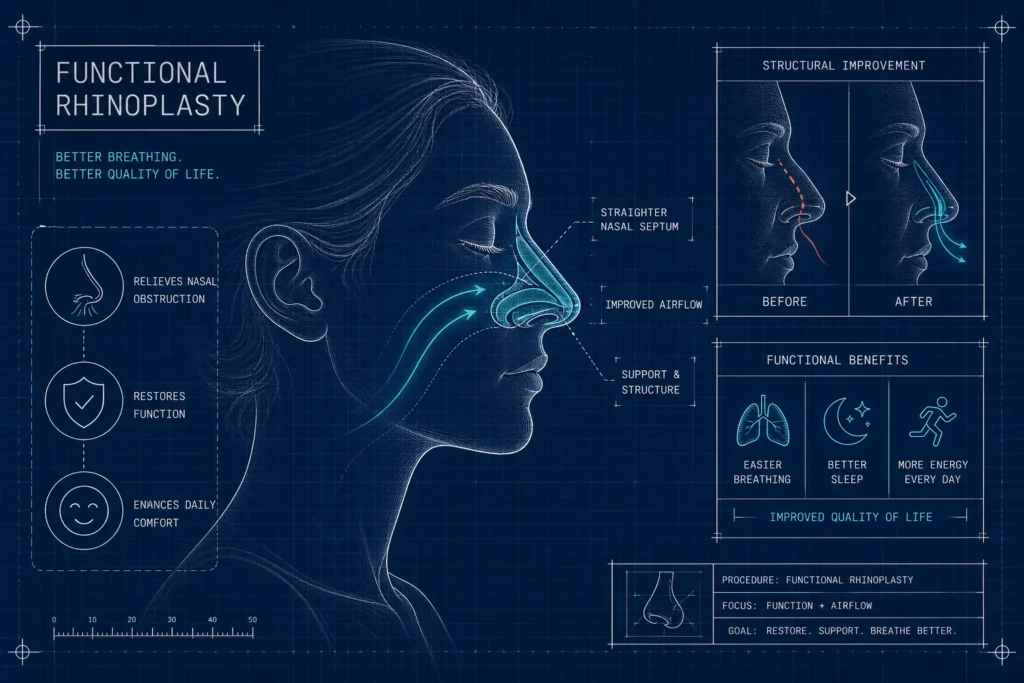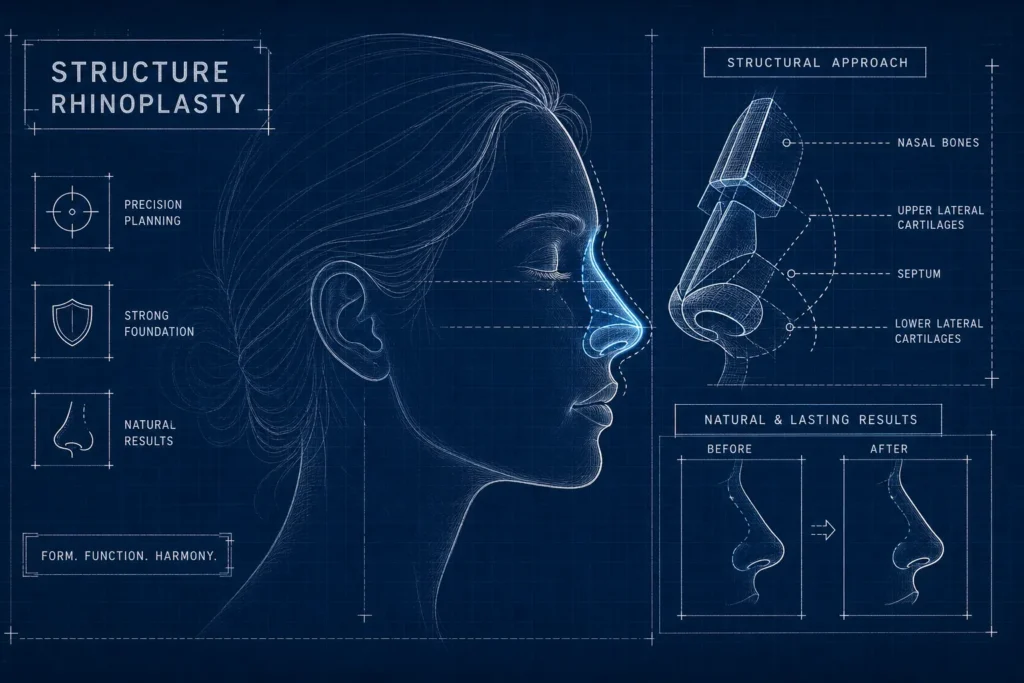
You’ve just had rhinoplasty abroad, and your return flight is already booked. The surgery went well, your surgeon is pleased, and you’re eager to get home. The real question isn’t whether you want to leave; it’s whether your nose is physiologically ready for the cabin. Many medical tourists face this exact situation every year, and the timing of that flight matters far more than most patients realize before booking.
This guide covers everything you need to make a safe, informed decision about flying home after rhinoplasty: what actually happens to your nasal tissues at cruising altitude, the surgeon-backed timelines for different procedure types and flight distances, the specific milestones you need to confirm before you board, and a concrete pre-flight and in-flight checklist. Surgeons who routinely treat international patients, including the team at Op. Dr. Ergün Kürün’s rhinoplasty clinic in Adana, Turkey, build their entire post-op protocol around the reality that patients fly home. That context shapes everything from the follow-up schedule to formal departure clearance.
When is it safe to fly home after rhinoplasty?
The short answer: most patients can fly safely within 7 to 14 days, depending on procedure type and flight distance. But reaching that window safely requires understanding what your nose is actually going through at altitude. Commercial aircraft cabins are pressurized to roughly the equivalent of 6,000 to 8,000 feet above sea level, a meaningful drop from the pressure at ground level. Within the first week post-op, that pressure differential creates a specific problem: trapped air in healing sinus cavities expands during ascent, pushing against freshly cut tissue. The result is sharp sinus pain, pronounced fullness, and pressure spikes that stress healing vasculature during both takeoff and descent. This isn’t just uncomfortable; it actively works against the tissues that are trying to stabilize.
Cabin air also runs at substantially reduced humidity, well below the levels most people encounter on the ground. This combination of dry air and reduced circulation efficiency causes fluid to redistribute into nasal tissues, intensifying the swelling that was just beginning to resolve. For a detailed timeline of how swelling changes after surgery, see When Does Swelling Subside After Rhinoplasty? A Guide for the First Week, 1 Month, and 6 Months. Flying too early can cause renewed puffiness that lingers for a day or two after landing. It won’t compromise your structural result, but it will extend your overall recovery and can be alarming if you’re not expecting it.
The third risk gets overlooked: deep vein thrombosis
Long-haul flights are a documented DVT risk for any post-surgical patient, and rhinoplasty patients face several compounding factors simultaneously. They’re less mobile, sometimes taking mild pain medications that affect circulation, and sitting in a dehydrated, low-pressure environment for hours. Flights over four hours amplify this risk meaningfully; for official guidance on travel after surgery and DVT risk, review NHS guidance on travel, surgery and DVT. Clinical literature also examines postoperative venous thromboembolism and travel-related risk factors in more depth (see supporting studies such as research on postoperative venous thromboembolism).
Signs of DVT include calf pain or tenderness, swelling in the leg, and skin that feels warm to the touch. Patients traveling transatlantic routes are often advised to allow a longer ground recovery period for this reason alone, not just for the sake of their nose.
When to fly after rhinoplasty: the timelines surgeons actually recommend
Splint or cast removal, which typically happens on day five to seven, is the gating milestone for air travel after rhinoplasty. It confirms that the structural phase of early healing is stable, active bleeding has resolved, and the nasal bones are no longer in the immediate post-fracture window. After splint removal, many surgeons will clear patients for short flights under three hours, provided there are no red-flag symptoms and surgeon clearance has been obtained. The key word is “minimum”: day five or seven is the floor, not the ideal departure window. For a broader month-by-month perspective on recovery and when common milestones occur, consult When Does the Swelling Subside After Rhinoplasty? The Rhinoplasty Recovery Process, Month by Month, Adana Burun Estetiği.
Short flights after rhinoplasty
For domestic or short-haul routes under three hours, the 5-to-7-day post-splint-removal window is a commonly cited starting point. That said, individual healing varies, and no calendar date overrides your surgeon’s direct assessment. Closed rhinoplasty patients with straightforward recoveries are generally the best candidates for the lower end of this range.
Long-haul flights after rhinoplasty
For flights over four hours, including any transatlantic route back to the United States, the clinical consensus among many surgeons lands at 10 to 14 days minimum, with a number of specialists recommending two to three weeks for optimal safety. Longer flight duration compounds every risk: more cumulative time at altitude, more immobility, greater pressure exposure, and more opportunity for in-flight nosebleeds that are genuinely difficult to manage at 35,000 feet without medical support. Waiting 10 to 14 days for a long-haul flight isn’t conservative hesitation; it’s the clinically smart choice, and it aligns with guidance summarized by several specialist clinics (see summaries such as Is it safe to fly after rhinoplasty? and How soon can you fly after rhinoplasty?), though specific recommendations vary by procedure and patient profile.
Revision rhinoplasty and flying
Revision rhinoplasty almost always uses an open approach and involves more extensive tissue work: cartilage grafting, scar tissue management, and structural rebuilding. These patients face a longer soft-tissue recovery window and should not apply standard primary rhinoplasty timelines to their situation. A patient who had a primary tip refinement and a patient who had a full revision with rib cartilage grafting are not in the same clinical position on day seven, regardless of what a general guideline says. For more on when revision might be necessary and how revision cases differ, see 9 Early Signs That May Indicate the Need for Revision Rhinoplasty | Dr. Ergün Kürün.
How your procedure type shifts the safe departure window
Closed rhinoplasty involves less tissue disruption, no external incision, and generally produces less post-op swelling, making the lower end of the timeline more achievable for short-haul flights. Open rhinoplasty, which accesses the full nasal structure through a columellar incision, produces more pronounced swelling and a longer period of tissue vulnerability. Patients who had open rhinoplasty should lean toward the 10-to-14-day window even for shorter domestic flights rather than trying to push toward the minimum. This is a conservative but sensible approach that many surgeons advise for open-technique cases.
For concurrent septoplasty, the timeline generally mirrors primary rhinoplasty. If the septal work was straightforward, the standard 7-to-14-day window applies. If the septoplasty was complex and involved spreader grafts or significant structural reconstruction, your surgeon’s individual clearance takes priority over any general guideline. No written resource replaces a direct assessment from the person who performed your surgery.
Clearance checkpoints to confirm before you book
Your first post-op visit is the most important appointment for international patients. Walk out of that appointment having confirmed the following: your splint or cast has been removed, there is no active bleeding or persistent drainage, there are no signs of infection such as fever, increasing redness, or worsening pain, and your surgeon has provided a fit-to-fly note or formal clearance. Airlines may or may not request documentation, but always obtain surgeon clearance regardless. That clearance exists for your protection, not the airline’s.
Certain warning signs push your departure back regardless of what day it is post-op. These include any active nosebleed or persistent drainage, fever above 38°C (100.4°F), a significant increase in facial swelling after splint removal, any sign of hematoma, or shortness of breath. Knowing these red flags isn’t fear-mongering; it’s pattern recognition. A patient who can identify these signals makes better decisions than one who’s just counting calendar days.
Ask your surgeon directly: “Is my internal healing on track, or are there any signs that could become problematic at altitude?” That question surfaces issues a simple visual exam might miss and gives you a clearer picture than any general timeline. If the answer is reassuring and all checkpoints are met, you can board with confidence. If there’s any hesitation, it’s worth knowing before you’re already at the gate.
Why international patients need a different post-op framework for air travel after rhinoplasty
A surgeon with a general domestic practice can space follow-up visits across weeks one, three, six, and twelve. International patients have one realistic window before departure: the five-to-seven-day post-op check. This means the quality and structure of that single visit carries enormous weight. A clinic not designed for international patients will give generic guidance; a clinic built around medical tourism builds specific departure clearance criteria into its standard workflow from the first consultation.
Op. Dr. Ergün Kürün’s clinic in Adana has developed a structured departure protocol designed specifically for patients returning home within seven days. Rather than a routine visual check, the protocol involves a thorough pre-departure assessment of internal healing and nasal function, giving both surgeon and patient concrete confidence before boarding. Patients receive a formal departure clearance summary, procedure-specific pre-flight instructions, and direct contact access for questions after landing.
This clinical checkpoint is built into the care model from day one, not added as an afterthought. For any patient considering rhinoplasty in Turkey and facing a transatlantic return, working with a surgeon whose protocol anticipates that departure isn’t a nice-to-have; it’s a fundamental part of safe care. Post-rhinoplasty travel guidelines are only as useful as the clinical structure behind them.
Your pre-flight and in-flight checklist for flying after rhinoplasty
In the 24 hours before you board, use a saline nasal spray the morning of departure to gently clear congestion without applying pressure. If your surgeon has approved it, use an oxymetazoline spray (such as Afrin) 30 to 45 minutes before boarding to reduce pressure sensitivity during ascent. Afrin is generally safe for short-term post-rhinoplasty use; stay within a two-to-three-day total usage window to avoid rebound congestion. Hydrate aggressively before the flight, drink water, not alcohol, and start well before you reach the gate.
Pack your post-op care items and all surgeon documentation in your carry-on, never in checked luggage. This includes gauze, saline spray, any prescribed medications in original packaging, and your departure clearance note. Wear comfortable, non-restrictive clothing. Avoid oral decongestants like Sudafed unless your surgeon or pharmacist has explicitly cleared them, as they may interact with post-op medications.
During the flight, keep your head slightly elevated using a travel pillow, especially if you sleep. Fluid pools when the head is flat, and even modest elevation helps. On long-haul routes, get up and walk the aisle every 60 to 90 minutes. Wear compression socks. Skip the alcohol completely; it dilates blood vessels and meaningfully increases the risk of nasal bleeding. Keep a folded gauze pad accessible in your carry-on.
If a mild nosebleed starts mid-flight, stay calm: apply gentle pressure to the soft part of the nose, tilt your head slightly forward (not backward), and breathe through your mouth. Most minor post-op nosebleeds resolve within a few minutes with gentle pressure. If bleeding is heavy, doesn’t respond to pressure within 10 to 15 minutes, or is accompanied by dizziness, alert the cabin crew and seek medical attention on arrival.
Getting home safely is part of the procedure
Flying home after rhinoplasty is safe when the timing and conditions are right. Most patients can reach that point within 7 to 14 days depending on procedure complexity and flight distance. The key isn’t just waiting long enough; it’s confirming the right milestones before you board: splint removed, no active bleeding, surgeon clearance in hand, and no red-flag symptoms present.
Surgeons who work with international patients regularly understand this calculus and design their protocols accordingly. If you’re evaluating rhinoplasty abroad, the post-op structure your surgeon offers matters as much as the surgical technique itself. A clinic that handles your departure as carefully as it handles your surgery is the one worth choosing.
If air travel after nasal surgery is part of your planning from the start, consult with a surgeon whose practice is built for that reality. Dr. Ergün Kürün’s clinic offers complimentary initial consultations, a starting point that gives you clinical clarity before you commit to anything, including the flight home.