
Revision Rhinoplasty

Revision rhinoplasty is a professional restoration process applied to address aesthetic and functional issues encountered in nose aesthetics. With this operation, which requires meticulous craftsmanship, technical equipment, and deep experience, we offer you a second chance to achieve the natural, breathable nose you envision.

Revision Rhinoplasty: A Second Chance and Functional Restoration

The inability to achieve the desired outcome after nose aesthetic operations or the emergence of functional problems over time is a challenging process for patients, both physically and psychologically. Revision Rhinoplasty (Correction Surgery) is one of the most technically demanding areas of surgery, performed for individuals who have undergone one or more previous nose operations but are not satisfied with the results.

As Op. Dr. Ergün Kürün, in our clinic in Adana, we approach revision surgery not merely as a correction, but as a “restoration process” that rebuilds the internal architecture of the nose.

What is Revision Rhinoplasty?

WHY IS IT NEEDED?

Irregularities remaining on the nasal dorsum after the initial operation, nasal tip drooping, asymmetries, or most importantly, persistent breathing problems, are the primary reasons for revision surgery.

Common Reasons for Revision

  • Aesthetic Concerns: Nasal dorsum collapse (saddle nose), axis deviation (asymmetry), or an excessively upturned/drooping nasal tip.

  • Functional Problems: Airway obstructions (valve narrowing) that develop or do not improve after the initial surgery.

  • Tissue Loss: Deformities resulting from excessive removal of cartilage support during the initial operation.

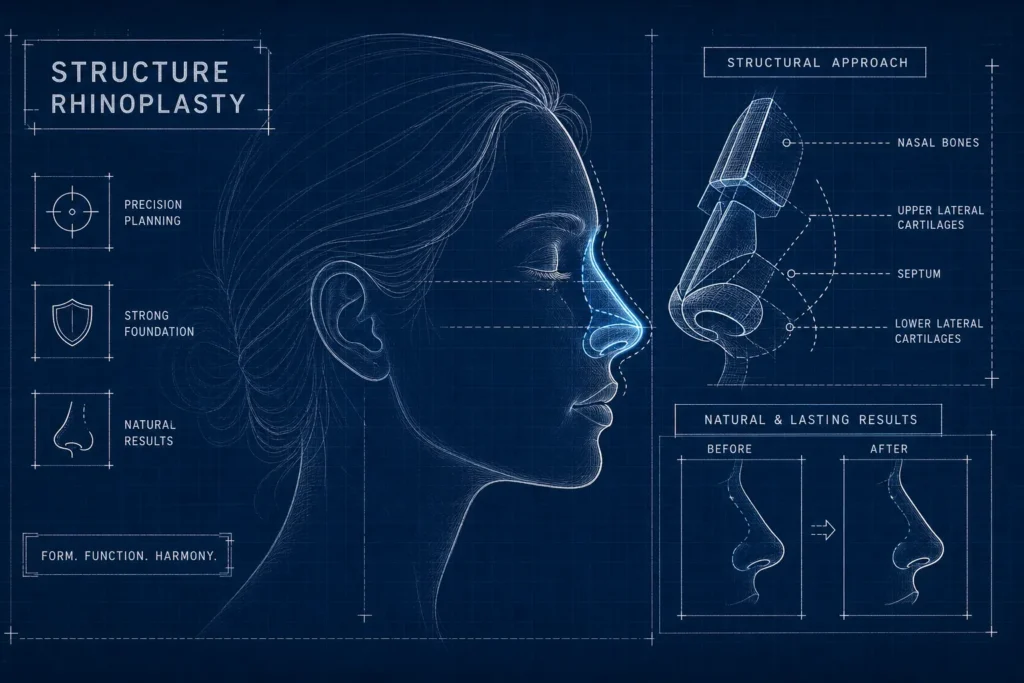
The Importance of a Structural (Structure)
Approach in Revision Surgery

In revision rhinoplasty cases, the internal nasal cartilage support (septum) is often weakened or depleted. Therefore, Structural Rhinoplasty techniques are vital for the nose to support its new form.

Cartilage Sources: Rib and Ear Grafts

When material (cartilage) is needed for nasal reconstruction, and if insufficient tissue remains within the nose, the following sources are utilized:

  • Rib Cartilage: The strongest and most abundant source of material. It is considered the “gold standard,” especially for correcting severe deformities.

  • Ear Cartilage: Preferred for smaller deformities and areas requiring flexibility.


Advanced Technology: Piezo and Precise Intervention in Revision

Previously operated bone tissue can be delicate and fragile. Ultrasonic Piezo Surgery technology allows us to smoothly reshape bones with sound waves in revision cases, without breaking them. This minimizes tissue damage and accelerates the healing process.

Revision Rhinoplasty

Revision Rhinoplasty Process and Expectations

Revision rhinoplasty is a more complex process than the initial surgery and may require more time for tissue healing.

When Should It Be Performed?

For a successful revision rhinoplasty, at least 1 year must have passed since the initial operation, with complete tissue healing and full resolution of edema.

Recovery Timeline

  • First Week: Swelling and bruising management (minimal with Piezo).

  • 1-3 Months: Establishment of the nose’s main contours.

  • 1-2 Years: Complete softening of tissues and clarification of the final result.


Revision Rhinoplasty Experience with Op. Dr. Ergün Kürün

When it comes to revision rhinoplasty in Adana, with over 30 years of experience, we transform complex cases into success stories. Our goal is to erase past mistakes and provide you with a nose that functions perfectly, both aesthetically and functionally.
Frequently Asked
Questions

REVISION RHINOPLASTY

Yes, it is surgically more complex. Due to existing scar tissue and cartilage deficiencies, the surgeon’s experience and technical equipment (Piezo, grafting, etc.) play a much more critical role.

Thanks to advanced techniques and small incisions, pain after rib cartilage harvesting is minimal, and the recovery process is quite fast.

Yes. With structural rhinoplasty and personalized design principles, the aim is to eliminate the “operated” appearance of the nose and achieve a natural form that is harmonious with the face.

Ideally, a permanent result is achieved with a single revision; however, multiple revisions can also be successfully performed with advanced techniques as long as tissue quality permits.

Absolutely. One of the primary goals of revision is to reconstruct the breathing function (valve mechanism) that was neglected or damaged in the initial surgery.

Start Your Journey of Change

TAKE THE FIRST STEP TOWARD ANALYSIS AND PERSONALIZED PLANNING

Schedule a Free Initial Consultation

Güncel Yaklaşımlar

RİNOPLASTİ DÜNYASINDAN GÜNCEL GELİŞMELER VE CERRAHİ NOTLAR

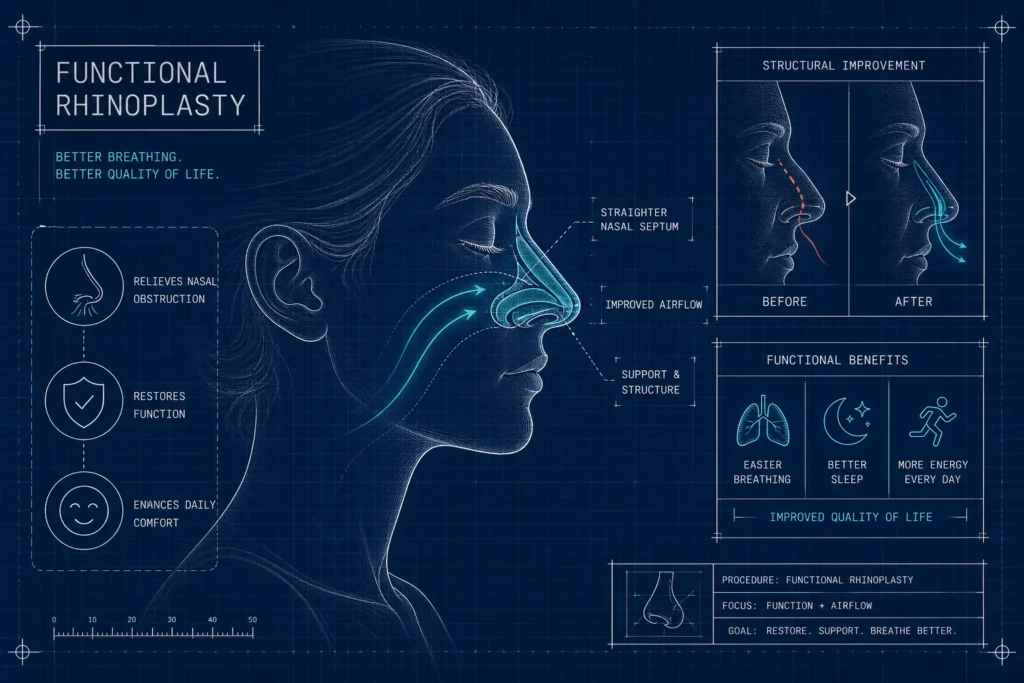
Functional Rhinoplasty: What It Treats and How It Works

Structure rhinoplasty explained: techniques and results

Septoplasty and Rhinoplasty at the Same Time: Is It Safe?