Most patients spend hours studying before-and-after photos and recovery timelines before choosing a rhinoplasty surgeon. Almost nobody asks the question that actually determines their satisfaction a decade from now: will this result still hold up in 15 years?
Nasal tip drooping, dorsal collapse, and uneven healing are among the most common regrets patients bring into revision consultations, and most of those problems trace directly back to a technique decision made on the original surgery day. The difference between conventional reductive rhinoplasty and structural rhinoplasty is not just a matter of surgical preference. It reflects two fundamentally different philosophies about what a nose needs to stay stable for life.
Does structural rhinoplasty give longer-lasting results than conventional nose surgery? Based on the available data on revision rates, graft stability, and long-term aging research, the answer consistently favors structural approaches for patients where durability is the priority. What follows covers the technique differences, what the durability data actually shows, how specific grafts perform over time, and the questions worth asking before committing to a surgical plan.
The fundamental difference: how each approach treats your nasal framework
Conventional rhinoplasty operates on a reductive model. The surgeon trims, scores, and removes cartilage and bone to reshape the nose. Results can look excellent on the day sutures come out. The problem is that removing structural tissue changes the nose’s load-bearing architecture. Dividing the tip support complex eliminates the ligamentous scaffolding the nose depends on to hold its shape against gravity and the contractile forces of healing scar tissue.
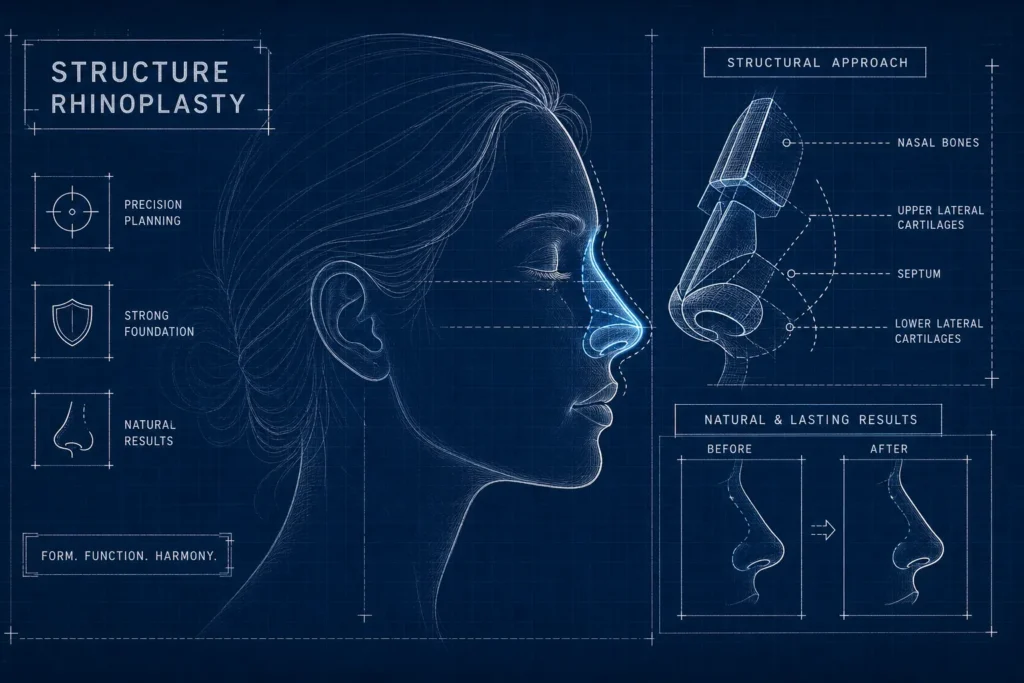
Structural rhinoplasty works in the opposite direction. Rather than removing tissue to reveal a new shape, it builds a reinforced cartilage framework first, then reshapes the surface around that framework. The primary tools are septal extension grafts, columellar struts, and spreader grafts, each serving a specific mechanical purpose. The reconstructed structure creates what surgeons call a “hard frame”: a rigid support system that resists the skin’s natural tendency to contract inward over years of healing. For a detailed explanation of the techniques used, see Structure Rhinoplasty (Yapısal Rinoplasti) | Op. Dr. Ergün Kürün.
Structural rhinoplasty is not the same as preservation rhinoplasty, though both represent an evolution beyond traditional reductive methods. Preservation rhinoplasty maintains existing native structures wherever possible. Structural rhinoplasty rebuilds support where it is weak or absent. Both approaches aim to outperform conventional techniques in long-term durability, and the available evidence generally supports that they do. For an overview of the current discussion around preservation versus structural strategies, see the discussion of preservation vs. structural approach in contemporary rhinoplasty trends.
Tip support is one of the most important variables in this conversation. When a surgeon divides the tip’s natural ligaments during conventional rhinoplasty, the tip loses its built-in resistance to downward migration. Without deliberate reconstruction of that support, gravity, scar contraction, and the gradual softening of cartilage over time increase the risk of the tip migrating lower. That process can take 5 years or 20 years, and in structurally unsupported noses, the risk is meaningfully elevated compared to supported ones.
Does structural rhinoplasty give longer-lasting results? What revision rate data reveals
The numbers tell a consistent story. Traditional open and closed rhinoplasty sit at a revision rate of 5% to 15% across large case series and peer-reviewed literature reviews. A large cosmetic rhinoplasty series in which 72.7% of cases used an open approach recorded an overall revision rate of 9.8%. A closed rhinoplasty cohort showed 8.6%, confirming that the open-versus-closed distinction matters far less than technique philosophy. Some industry and registry data suggest that structural collapse from aggressive tissue reduction contributes to revision need in a significant proportion of traditional cases, though peer-reviewed estimates vary (see a representative revision rate study).
Preservation-aligned approaches produce a meaningfully different picture. A 2017 retrospective cohort study by Foulad et al. reported a 1.80% revision rate for a preservation-based technique versus 5.30% in the traditional group during the same study period. A 2022 randomized controlled trial by Gentile and Cervelli found 82.9% excellent outcomes in the preservation group compared to 40% in the traditional control group. It is worth noting that these studies specifically compare preservation techniques to traditional rhinoplasty; preservation and structural approaches are related but distinct concepts in the surgical literature. Structural techniques in a number of published clinical series report revision rates below 5%, though large-scale randomized comparisons specific to structural rhinoplasty versus traditional rhinoplasty remain limited.
The gap between these figures is not marginal. It reflects a philosophical difference in how the nasal framework is treated, not just a difference in surgeon skill. Based on the Foulad data and comparable series, patients treated with preservation- or structure-focused approaches show revision rates roughly two to three times lower than those treated with conventional reductive techniques. The most important confounding variable in any comparison is surgeon experience with cartilage grafting, because structural techniques require a level of grafting precision that takes years to master.
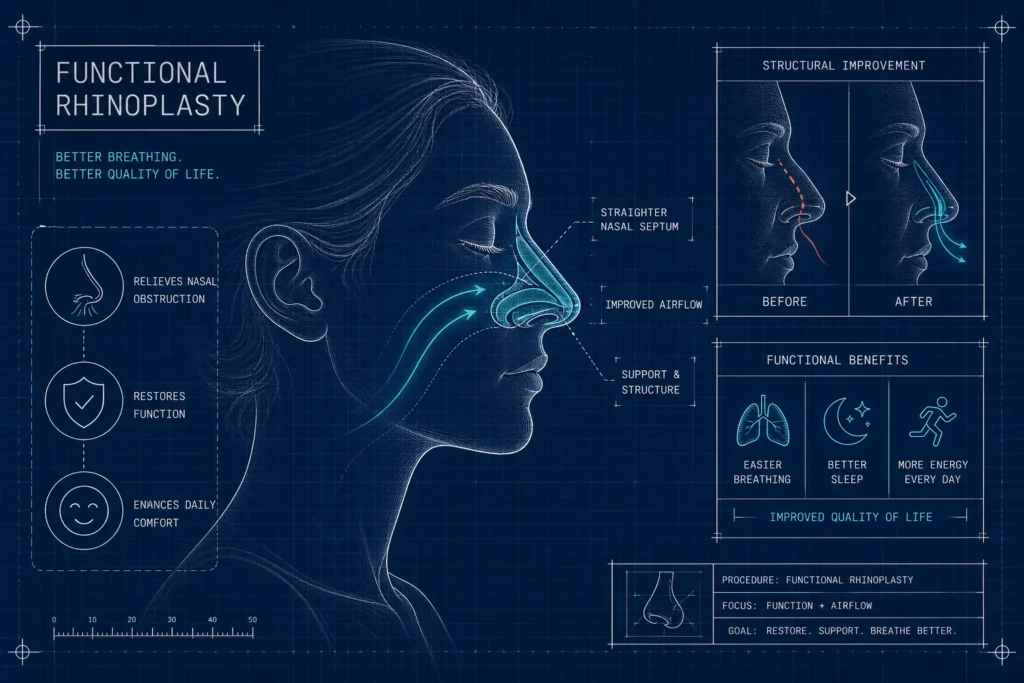
One finding worth noting: breathing difficulties account for approximately 40% of all secondary rhinoplasty procedures across technique categories. This is precisely why ENT-trained surgeons hold a structural advantage. Functional airway management is built into their surgical training from the start, not added as an afterthought. For more on how functional issues factor into surgical planning, see What Is Functional Rhinoplasty?, Adana Burun Estetiği.
The grafts that determine how long your result lasts
Septal extension grafts
Not all cartilage grafts perform equally over time. Septal extension grafts and columellar struts both target tip support, but they produce dramatically different long-term outcomes. Studies with average follow-up of 3.3 years (ranging from two to over six years) show that septal extension grafts produce only a 0.2% loss in tip projection and 1.3 degrees of rotation loss at one year post-operation.
The mechanism explains why. A septal extension graft creates a fixed midline platform anchored rigidly to the septum, which resists the contractile forces of healing that would otherwise pull an unsupported tip downward. Published data indicates that septal extension grafts provide substantially greater resistance to tip drooping compared to columellar struts, with some series reporting the advantage at roughly 66% greater resistance to positional drift relative to pre-operative baseline measurements.
Columellar struts
Columellar struts show 4.7% projection loss and 4.9 degrees of rotation loss over comparable follow-up periods. A columellar strut is a floating structure with no rigid anchor point. Over 12 to 18 months of scar maturation, contractile forces systematically pull the lengthened tip back toward where the scar tissue wants it to settle. It provides initial support but limited long-term resistance compared to a septally anchored graft.
Spreader grafts
Spreader grafts serve a separate but equally important function. They stabilize the middle vault, tension the lower lateral cartilages, and prevent internal valve collapse. In published structural rhinoplasty series, spreader grafts are used alongside septal extension grafts in over 92% of cases, addressing dorsal stability and nasal airway function simultaneously. Without middle vault support, the dorsum can shift laterally even when tip support is solid, creating an uneven appearance years after surgery that no surface treatment will correct.
Tip stability and dorsal stability are two separate structural problems requiring two separate solutions. A complete structural approach uses septal extension grafts for the tip and spreader grafts for the dorsum as a coordinated system. Addressing one without the other leaves the framework incomplete.
How aging changes the nose over 20 years
Surgery does not freeze the nose in time. Understanding normal nasal aging is part of making an informed technique decision, because the structural choices made on surgery day determine how gracefully, or how badly, the nose ages over the following two decades.
The predictable changes follow a recognizable timeline. Tip drooping (nasal ptosis) typically begins appearing 5 to 20 or more years post-operation as cartilage weakens and skin loses elasticity. Skin elasticity loss, usually noticeable at 10 or more years, can reveal irregularities that were invisible earlier in healing. Fat and soft-tissue atrophy at 15 to 20 or more years can make the nose appear disproportionately larger relative to the face as surrounding facial volume reduces. These are normal biological processes that affect every nose, operated or not.
What conventional reductive rhinoplasty does is accelerate the negative effects of these changes. Removing too much cartilage eliminates the structural support that resists contractile forces during healing. Published data suggests that structural instability from aggressive reduction can become apparent as early as five years post-operation, far earlier than most patients anticipate when they leave surgery satisfied. Long-term follow-up data from studies tracking outcomes beyond ten years indicates that noses with adequate support grafts maintain structural position more reliably over time than those without, though the biology of this involves soft-tissue stabilization rather than literal bony fusion. See a relevant long-term follow-up study for more on aging-related outcomes.
A structurally supported nose ages in harmony with the rest of the face rather than collapsing into a shape the patient no longer recognizes. The goal is not a nose that looks identical at 60 as it did at 30. The goal is a nose that remains proportionate and balanced as the entire face matures alongside it.
When structural is the right choice (and when it genuinely isn’t)
Structural rhinoplasty is the strongest choice in several specific clinical situations. Revision rhinoplasty almost always requires a structural approach because prior surgery has already compromised the framework, and grafting is the only way to rebuild what was removed. Patients with naturally soft or weak cartilage need a constructed support system before any surface reshaping is safe. Any case involving significant septal deviation, nasal valve collapse, or a meaningful breathing problem is a strong candidate for structural correction. Patients who are planning one surgery for life, rather than one surgery followed by a revision in ten years, benefit from the structural approach’s documented durability advantage.
The limitations of structural rhinoplasty deserve honest acknowledgment. It is more invasive by design: more dissection, longer operating time, and typically a longer swelling phase, particularly in patients with thick skin. Graft resorption is a known risk; while less common with septal cartilage than with auricular or costal grafts, any graft carries a possibility of partial resorption that could require correction. Structural rhinoplasty is also not always necessary. Patients with favorable dorsal anatomy, stable tip support, and well-preserved septal cartilage may achieve equally durable results with preservation-focused techniques. Choosing a structural approach for a nose that doesn’t need it adds unnecessary complexity.
Before committing to a surgical plan, these are the questions worth asking directly:
- “What graft type are you planning for my tip, and why that specific choice for my anatomy?”
- “Can you show me results at five or more years in patients with a similar cartilage and skin profile to mine?”
- “What is your personal revision rate for primary rhinoplasty?”
- “If my tip droops in ten years, what would correction involve?”
A surgeon who answers these questions specifically and without hesitation has thought structurally about your case. A surgeon who gives vague answers is worth a second opinion.
Dr. Ergün Kürün’s structural approach: where ENT expertise shapes longevity
ENT training changes how a surgeon reads the nose. At Op. Dr. Ergün Kürün’s clinic in Adana, Turkey, the nasal airway, septum, and turbinates are treated as structural components that affect both function and the long-term stability of aesthetic results. With over 25 years of ENT surgical experience, Dr. Kürün’s approach integrates structural planning for the airway the framework contains, not just the shape it creates at the surface.
Every patient receives a pre-surgical digital plan built on facial proportion analysis, mapping structural graft decisions to the specific anatomy before the first incision. The initial consultation includes an endoscopic nasal function evaluation that identifies existing structural weaknesses influencing graft selection and long-term stability planning. This pre-surgical structural assessment is where most of the long-term outcome is determined, not in the operating room alone.
The consultation at Op. Dr. Ergün Kürün’s clinic focuses on three structural questions: where is your tip support now, where do you want it in 20 years, and which graft strategy achieves that with the lowest revision risk for your specific anatomy. Patients leave that conversation with a clear explanation of the planned technique, including why it was chosen for their cartilage quality, skin thickness, and surgical history. That level of pre-surgical transparency is the foundation of rhinoplasty results that hold up over decades, not just in recovery photos.
Structural vs. conventional rhinoplasty: what the evidence shows
The evidence on this question does not point in two directions. Revision rates in the range of 1.8% to under 5% for preservation- and structure-aligned techniques versus 5% to 15% for traditional approaches, septal extension graft stability data against columellar strut performance, and long-term follow-up research confirming that support grafts resist positional drift over decades all point toward the same conclusion: when tip drooping, structural collapse, or revision risk is a concern, structural techniques outperform conventional reductive approaches by a measurable margin in the available literature.
Technique quality and execution matter as much as technique selection. Graft choice, surgical precision, and genuine experience with cartilage support systems all determine whether the structural advantage holds in any individual case. A structurally sound plan executed imprecisely will underperform a well-executed conventional approach in the right candidate.
If long-term results matter as much to you as the surgery itself, the right time to ask structural questions is at the consultation, not at a revision appointment five years from now. Op. Dr. Ergün Kürün’s clinic structures every consultation around exactly that conversation, starting with an endoscopic assessment and a specific answer about what your nose’s architecture needs to last. Contact the clinic to schedule your initial evaluation and discuss which approach is right for your anatomy. For guidance on candidacy and whether structural or preservation techniques suit you, consider reviewing Who Is a Good Candidate for Rhinoplasty? | Dr. Ergün Kürün, M.D..