Nose surgery (rhinoplasty) is a surgical milestone that not only alters the shape of an organ located right in the center of the face but also directly affects a person’s facial expression, self-confidence, and, most importantly, quality of life. Although it is one of the most commonly performed cosmetic procedures today, it is also one of the surgeries most likely to require revision surgery if not properly planned.
So, even though thousands of people undergo rhinoplasty every year, why is it that a significant number of them are unhappy with the results or choose the wrong surgeon?
The biggest factor behind this situation is the illusion created by social media and beauty filters. “Before-and-after” photos shared on Instagram or TikTok—which appear flawless under intense lighting and from a single angle—can lead patients to lose sight of the reality of surgery. It is important to remember that rhinoplasty is not just a two-dimensional screen image; it is about breathing comfort, the overall balance of facial features, bone and cartilage anatomy, and, most importantly, structural stability that will last a lifetime.
A truly successful and timeless rhinoplasty is one that leaves the patient feeling natural every time they look in the mirror and allows them to breathe freely at night. The first step toward achieving this satisfaction is a thorough, transparent, and probing consultation with your surgeon before you go under the knife.
Questions to ask before rhinoplasty should focus on the surgeon’s experience, surgical technique, approach to achieving a natural appearance, breathing function, the recovery process, the likelihood of revision surgery, and realistic expectations.
1. What Is the Surgeon’s Experience with Rhinoplasty?
Rhinoplasty is the most dynamic surgical procedure in the fields of plastic surgery and otolaryngology. Each patient’s anatomy, cartilage strength, and skin thickness are completely different from one another. For this reason, your surgeon’s “muscle memory” and the variety of cases they have encountered are of critical importance, even more so than their theoretical knowledge.
How Many Cases a Year?
Don’t hesitate to ask your surgeon directly how many rhinoplasty procedures they perform each year. A surgeon who performs this procedure regularly—whether weekly or monthly—and has dedicated their focus to nasal anatomy and the latest techniques is always one step ahead when it comes to managing complications.
Experience with Primary vs. Revision Rhinoplasty
If you are having surgery for the first time, it is called “primary rhinoplasty.” However, it is also important to know how experienced your surgeon is in performing revision (secondary) surgery—that is, correcting noses where previous procedures have failed. A surgeon capable of performing revision surgery has a thorough understanding of the limits of nasal anatomy and cartilage engineering.
What Should You Look for When Evaluating Before-and-After Photos?
When reviewing the portfolio presented to you, don’t just focus on the beauty of the nose.
Make sure the photos are taken from different angles (full profile, front, at an angle, and from below so that the nostrils are visible).
Review cases similar to your skin type (for example, if you have thick skin, look at the results for patients with thick skin).
Not Just a Beautiful Result, but a Natural One: Instead of overly sculpted noses that look obviously surgically altered even from a distance, look for results that blend seamlessly with the face’s other features (chin, forehead, eyes) and look as if they were “part of you.”
When choosing a doctor for rhinoplasty, you should not rely solely on Instagram results; instead, you should consider the surgeon’s range of cases, their approach to achieving natural-looking results, and their long-term outcomes.
2. Is It Really Possible to Get a Nose That Suits My Facial Structure?
One of the biggest mistakes in cosmetic surgery is trying to apply a single, standardized nose shape to every face. A nose shape that’s very popular on social media might look completely unnatural and unattractive on your face.
WHY IS GETTING A "CELEBRITY NOSE" RISKY?
The angle or curve of the tip of the nose that looks great on someone else may not harmonize with your forehead-to-nose angle, chin projection, and eye spacing. “Copy-paste” noses erase a person’s distinctive facial expression and result in an artificial, mask-like appearance.
Population Ratios and Ethnic Composition
According to the rules of the golden ratio, the face is divided vertically into three equal parts. The length and projection of the nose (the distance from the front to the tip) must adhere to these proportions. In addition, a person’s ethnic background (Mediterranean, Asian, or African American) determines the characteristics of the cartilage and skin. To achieve a natural appearance, the features must be refined without completely erasing the person’s ethnic identity.
Differences in Male and Female Facial Anatomy
In male facial anatomy, the bridge of the nose should be straight (with a straight profile), and the angle between the tip of the nose and the lip (the nasolabial angle) should be around 90–95 degrees. In women, however, a slight curve (supratip break) and an elevation of 95–105 degrees are considered aesthetically pleasing. Creating a feminine-looking nose for a male patient negatively affects his masculine facial features.
3. Will my breathing function be evaluated as well as the appearance of my nose?
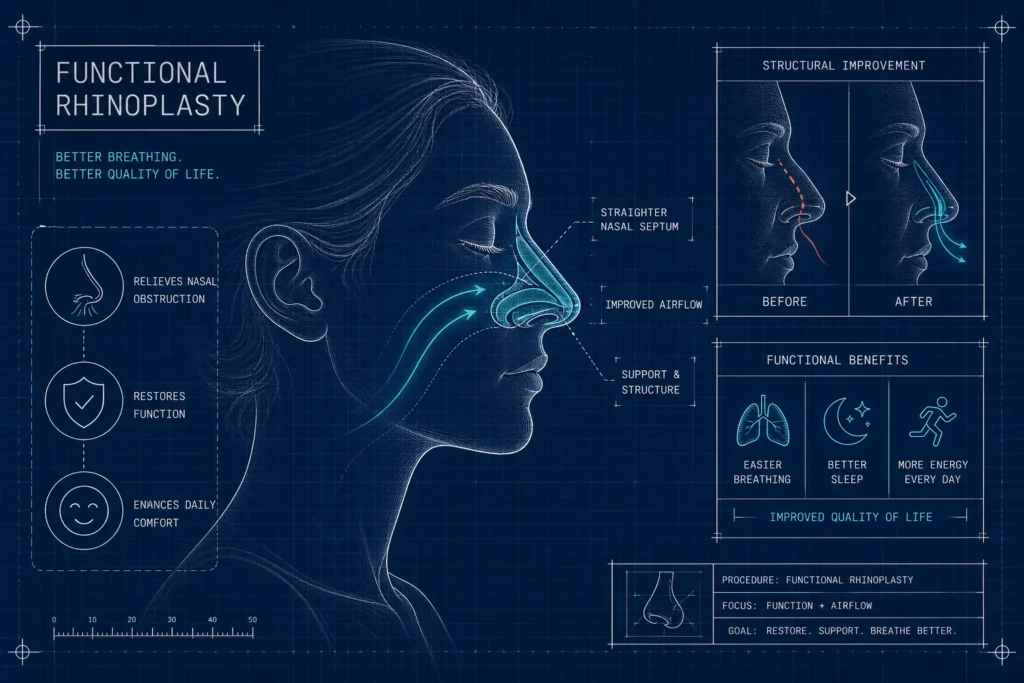
A nose that looks good but doesn’t allow the patient to breathe properly is a failed surgery. When planning a rhinoplasty, the inside and outside of the nose must be considered as a whole.
Nasal Septum Deviation: The cartilage and bone deformities in the central partition of the nose must be completely corrected during surgery.
Nasal Polyps: Nasal polyps that have grown due to allergic or structural causes should be treated with radiofrequency or appropriate surgical procedures.
Valve Problems (Internal and External Nasal Valves): These are the air passages that prevent the nostrils from collapsing inward during inhalation. Weakening this structure during surgery causes permanent shortness of breath.
During your preoperative examination, you should make sure that your surgeon examines the inside of your nose endoscopically and incorporates the principles of functional rhinoplasty into the treatment plan.
Scientific Standards in Nasal Valve and Airway Management
Aesthetic success in rhinoplasty is directly related to the preservation of the intranasal respiratory mechanism. In particular, surgical interventions performed on the internal and external nasal valve regions have geometric effects on airway resistance. Thousands of clinical cases have been analyzed in the international medical literature and peer-reviewed otolaryngology journals regarding grafting techniques developed to preserve respiratory function during aesthetic surgery and long-term patient satisfaction. If you would like to review global studies on the functional dynamics of nasal anatomy and the integration of aesthetics with surgery from an independent source, you can browse current scientific articles on functional rhinoplasty and airway management published in PubMed / National Institutes of Health, one of the medical world’s most respected biomedical databases.
4. What Procedure Will Be Performed on Me, and Why?
In modern rhinoplasty, there is no single “correct” technique; instead, there are approaches tailored to the patient’s needs. You should ask your surgeon why they are recommending that particular technique.
Open Rhinoplasty: This technique involves making an incision in the small strip of skin between the nostrils (the columella) to completely lift the nasal skin. It provides a very wide field of view, giving the surgeon full control, especially in cases of asymmetrical, crooked, or revision noses.
Closed Rhinoplasty: This is a technique in which all incisions are made inside the nostrils, leaving no external scars. Because the overlying tissue sustains less damage, early-stage swelling subsides more quickly.
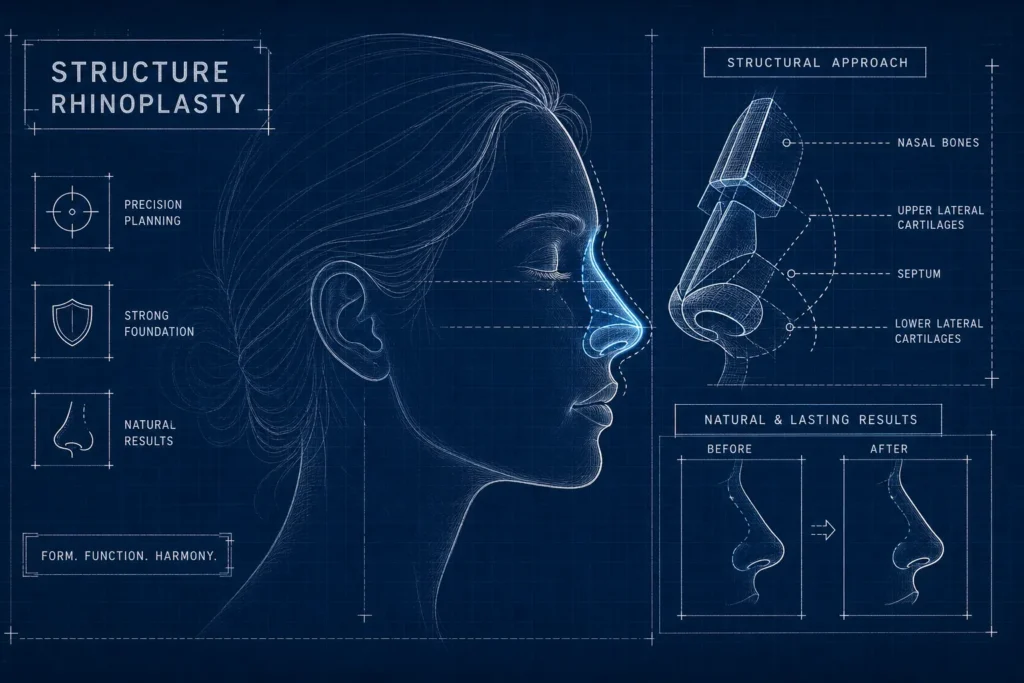
Preservation Approach: This is the philosophy of lowering the nose (Letdown/Pushdown) by removing bone and cartilage from below, without compromising the natural anatomical ligaments and cartilage integrity of the nasal bridge. Ligament-preserving techniques help maintain the natural shape of the nasal bridge after surgery.
| Özellik | Açık Rinoplasti | Kapalı Rinoplasti | Koruyucu (Preservation) |
|---|---|---|---|
| Görüş Alanı | Maksimum (Tam Görüş kontrolü sağlar) | Kısıtlı / Endoskopik asistanlık gerektirebilir | Spesifik ve sınırlı alan odaklıdır |
| Dışarıda İz | Kolumellada milimetrik ve zamanla belirsizleşen iz | Kesinlikle iz kalmaz (Kesiler içeridedir) | Kesinlikle iz kalmaz (Kesiler içeridedir) |
| İyileşme Hızı | Standart (Ödemlerin inmesi zamana yayılır) | Hızlı (Doku bütünlüğü korunduğu için) | Çok Hızlı (Bağlar ve kıkırdak sırtı korunur) |
| Endikasyon | Kompleks, asimetrik ve revizyon vakalar | Hafif ve orta düzeyde deformasyonlar | Uygun burun sırtı ve kemer anatomisi |
5. How Natural Will the Result Look?
A natural look means that even years after surgery, the nose does not sag, does not look as if it were pinched shut (pinched nose), and is not the first thing that catches the eye when looking at the face.
Risk of an Excessively Raised Nose: When the tip of the nose is raised excessively, the nostrils become directly visible when viewed from the front. This not only creates an unnatural appearance but also causes functional problems because the mucous membranes dry out.
Timeless Aesthetics: Instead of the “trendy” nose shapes dictated by popular culture, you should opt for timeless designs that will harmonize with your aging facial features even 20 to 30 years from now.
Profile and Frontal View Balance: Patients often focus solely on the profile view (side view). However, in social situations, people look at you from the front and at an angle 90% of the time. The width and asymmetries of the nasal bridge in the frontal view must be planned with at least as much precision as the profile.
6. How Does the Healing Process Actually Proceed?
Once rhinoplasty surgery is complete, the process has actually just begun. Understanding the timeline of the nose’s biological healing process will help you maintain your emotional well-being as you go through the various changes you’ll experience.
First Week (Splint and Pad Phase): You may experience bruising and swelling around the eyes. The new-generation silicone pads allow you to breathe. 7. The cast and stitches are removed daily.
First Month: This is the period when swelling is at its peak, and the nose appears asymmetrical and coarser than usual. You must be patient.
Months 3–6: The swelling on the bridge of the nose subsides significantly, and the contours of the nose begin to become more defined. The tip of the nose is still firm.
1st Year (Final Result): Microscopic healing beneath the skin is complete, the cartilage settles into place, and the final shape of the nose becomes apparent. In patients with thick skin, this process may take up to 2 years.
The Psychology of Swelling
Checking the mirror every day after surgery to look for minute changes can be psychologically draining for the patient. Knowing that swelling won’t subside at the same rate on both sides—and that you’ll wake up to a more swollen nose in the morning and find it less swollen by evening—you should view this process as a “journey of patience.”

7. Is There a Chance I’ll Need Revision Surgery?
In honest communication with a surgeon, the answer to this question should never be “No, it’s impossible.” Even the world’s best rhinoplasty surgeons have revision rates ranging from 5% to 15%, according to the literature.
Why Is a Revision Necessary?
During the healing process, factors beyond the surgeon’s control—such as the asymmetric memory of the cartilage, excessive scar tissue formation, or the patient sustaining an impact—may necessitate minor or major revision surgery.
Red Flag Answers
If a surgeon makes a definitive and unscientific promise to you—such as , “There are never any problems with my surgeries; the likelihood of revision is zero” —this is not a realistic approach and is a serious red flag. The right doctor is one who transparently explains the potential risks to you and how they would handle a problem if it were to arise (their revision policy).
8. What Are the Risks and Possible Complications?
As with any surgical procedure, rhinoplasty has its own specific risks. Knowing these risks in advance and learning how your surgeon takes precautions against these complications will help ease your anxiety.
Prolonged Swelling: Especially in patients with thick and oily skin, swelling can persist for months and delay the shaping of the tip of the nose.
Asymmetry: Slight asymmetries between the two nostrils or the sides of the nose are a natural occurrence. However, significant asymmetries may require surgical intervention.
Possibility of a Minor Touch-Up: Sometimes, under local anesthesia, minor touch-ups—such as filing down a small cartilage irregularity on the bridge of the nose—may be required, taking about 10–15 minutes.
9. To What Extent Do Simulation Images Reflect the Actual Results?
Preoperative digital 3D simulations or 2D profile drawings are excellent communication tools that enable the surgeon and the patient to speak the same aesthetic language. However, they are not “guarantees.”
The Limits of Digital Simulation: It is very easy to manipulate pixels on a computer screen; however, during surgery, the surgeon works with living tissue, the rigidity of bone, and the elasticity of the skin.
Expectation Management (Promise vs. Possibility): The simulation does not provide a definitive image (promise) of what your nose will look like after surgery; rather, it shows what might suit your face and the likely limitations of the surgery (possibility).
10. When Can I Return to Social Life and Work After Rhinoplasty?
When planning your surgery, it is important to coordinate your social and professional schedules properly to avoid stress.
Work Life: If you have a desk job, you can return to work 7 to 10 days after the cast is removed. For jobs that require physical strength, you should wait at least 3 weeks.
Use of Eyeglasses: Since bone healing is critical, heavy eyeglasses should not be worn for the first 2–3 months after surgery. If necessary, the process should be managed by wearing lightweight eyeglasses suspended by a strap or by opting for contact lenses.
Activity Calendar: What Can Be Done When?
| Aktivite | Güvenli Başlangıç Zamanı | Dikkat Edilmesi Gerekenler |
|---|---|---|
| Masa Başı İş | 7 - 10. Gün | Ödemlerin henüz tamamen geçmediği ve burnun hassas olduğu bilinmelidir. |
| Hafif Yürüyüşler | 2. Hafta | Kan basıncını ve nabzı aşırı yükseltmeyecek kontrollü tempoda olmalıdır. |
| Ağır Spor / Fitness | 6. Hafta | Yüz içi basıncı artıracak ıkınma, ağır kaldırma ve başı öne eğme hareketlerinden kaçınılmalıdır. |
| Yüzme / Deniz | 1. Ay | Burun içi mukozanın korunması adına havuz enfeksiyon risklerine karşı steril tesisler seçilmelidir. |
| Uçak Yolculuğu | 10. Gün | Kabin basıncı kuruluğa yol açabileceğinden hekimin önerdiği nemlendirici spreyler aksatılmamalıdır. |
| Gözlük Kullanımı | 3. Ay | Kemik iyileşmesi tamamlanana kadar ağır çerçeveler yerine lens veya banta asılan çok hafif gözlükler tercih edilmelidir. |
11. Is Now Really the Right Time for Me to Have This Surgery?
Deciding to undergo rhinoplasty is a process that requires not only physical but also psychological preparation. Before consulting with your surgeon, you should carefully consider whether you are truly ready for this surgery.
External Pressure vs. Personal Decision: You should have the surgery not because of pressure from the people around you, your friends, or criticism on social media, but simply because, when you look in the mirror, you truly want this change.
Trend-Driven Decisions: Radical changes to your appearance made simply because you’re following a passing trend can lead to regrets later in life. Give yourself time to let your decision mature.
Red Flags Before Rhinoplasty
If you encounter any of the following situations while searching for a surgeon, it may be in your best interest to reconsider your decision:
An Excessively Cheap and Price-Focused Approach: The quality of the hospital where the surgery will be performed, the anesthesiologist’s experience, and the standards of the surgical equipment are all factored into the price. Do not entrust your health to unlicensed, back-alley operations that operate far below market rates.
10-Minute Rush Exams: Stay away from “assembly-line” processes where the doctor doesn’t listen to your symptoms, doesn’t examine your nasal functions with an endoscope, and doesn’t discuss your condition in detail.
The Same Nose Style for Everyone: If all the noses in a surgeon’s portfolio look exactly alike, it means that surgeon isn’t creating designs tailored to each patient’s facial structure.
Posts with Heavy Filters and Photoshop: Surgical photos that have been unrealistically smoothed out and have imperfections hidden by light flares do not reflect surgical integrity.
Mini Checklist Before Rhinoplasty
Before finalizing your surgery date, you should be able to confidently answer “Yes” to all of the following points:
[ ] I thoroughly researched my surgeon’s experience, case volume, and revision policy.
[ ] I underwent an examination of the inside of my nose; my septum, turbinates, and nasal valves were evaluated.
[ ] When I looked in the mirror, I clearly explained to my surgeon what I wanted to change.
[ ] We agreed on a design for the digital simulation that suits my face and isn’t too over-the-top.
[ ] I have come to terms psychologically with the timeline of my recovery and the swelling that occurred during the first year after surgery.
[ ] I have a realistic understanding of the potential risks, complications, and revision rates.
What questions should you ask before getting a nose job?
Before surgery, you should definitely ask the surgeon about their experience with rhinoplasty cases, which technique (open, closed, or conservative) they will choose and why, how the nasal airways will be corrected, and their policy regarding revision surgery.
How do you choose the best rhinoplasty surgeon?
The best surgeon is one who focuses on medical and functional principles rather than popular social media trends, creates designs tailored to the patient’s facial proportions, and has a thorough command of the principles of otolaryngology and plastic surgery.
Is a natural-looking result possible in rhinoplasty?
Yes, completely natural results are achieved when the bridge of the nose is not excessively carved down, the cartilages at the tip of the nose are shaped with smooth transitions so that they are not visible from the outside, and the overall proportions of the face are preserved.
Does breathing improve after rhinoplasty?
In a properly planned functional rhinoplasty procedure, because deviations in the internal cartilage (septal deviation) and the nasal turbinates (conchae) are also corrected while the external shape of the nose is being reshaped, the quality of breathing improves significantly after surgery.
When can the full results of rhinoplasty be seen?
The final results of rhinoplasty usually become apparent by the end of the first year. However, in patients with thick nasal skin, it may take 1.5 to 2 years for lymphatic drainage to complete and for swelling to fully subside.
Why is revision surgery necessary?
Depressions in the nasal structure, cartilage displacement, excessive drooping of the nasal tip, or breathing difficulties caused by uncontrolled scar tissue formation during the healing process following the initial surgery may require revision (secondary) surgery.
Which is better: open or closed rhinoplasty?
Both techniques have their own unique advantages. Open rhinoplasty offers advantages for complex and crooked noses by providing the surgeon with maximum visibility, while closed rhinoplasty stands out for leaving no external scars and allowing for a faster recovery. The best technique is the one your doctor chooses based on the anatomy of your nose.
Is rhinoplasty very painful?
Thanks to advances in anesthesia techniques and local blocks administered during surgery, pain after rhinoplasty is minimal. Patients typically mention the sensation of fullness caused by nasal congestion during the first few days rather than pain.
When can I resume exercising after rhinoplasty?
You can start taking light walks starting in the second week after surgery. However, it is recommended to wait at least 4 to 6 weeks before engaging in strenuous sports, fitness activities, weightlifting, and pool or ocean activities.
Is rhinoplasty permanent?
Yes, the bone and cartilage structure reconstructed through rhinoplasty is permanent. However, as with all facial tissues, very slight, natural sagging may occur in the skin and ligaments of the nose as part of the aging process.