Signs of a Failed Nose Job are among the topics most frequently searched by patients after rhinoplasty. In particular, people who notice a difference in their nose after surgery may ask questions such as, “Is my nose crooked?”, “Has the tip of my nose drooped?”, or “Do I need revision surgery?”
Swelling, asymmetry, and changes in facial expression—especially during the first few weeks or months—may cause concern for some people.
However, there is one important point we must not forget:
The early-stage image is not the same as the final result.
Not every change observed after rhinoplasty indicates a failed procedure. While some changes are a natural part of the healing process, others may require a more detailed evaluation.
So, what are the signs of a failed rhinoplasty?
Do the Signs of a Failed Rhinoplasty Always Appear Within the First Few Weeks?
No.
In the immediate post-rhinoplasty period:
- Edema
- Stiffness of the tip of the nose
- Temporary asymmetries
- Changes in facial expressions
- A different appearance caused by swelling
can be seen.
These changes are often a natural part of the healing process.
Especially during the first few months:
“My nose looks crooked.”
“One side is different from the other.”
Comments like these are common.
It may take some time to reach a final assessment.
Development of a Noticeable Deviation in the Nose
After recovery is complete:
- A sensation of slipping on the bridge of the nose
- A noticeable deviation of the nose to one side
- A noticeable curve in the front view
Situations like these may occur.
However, minor differences in the payment period can be misleading.

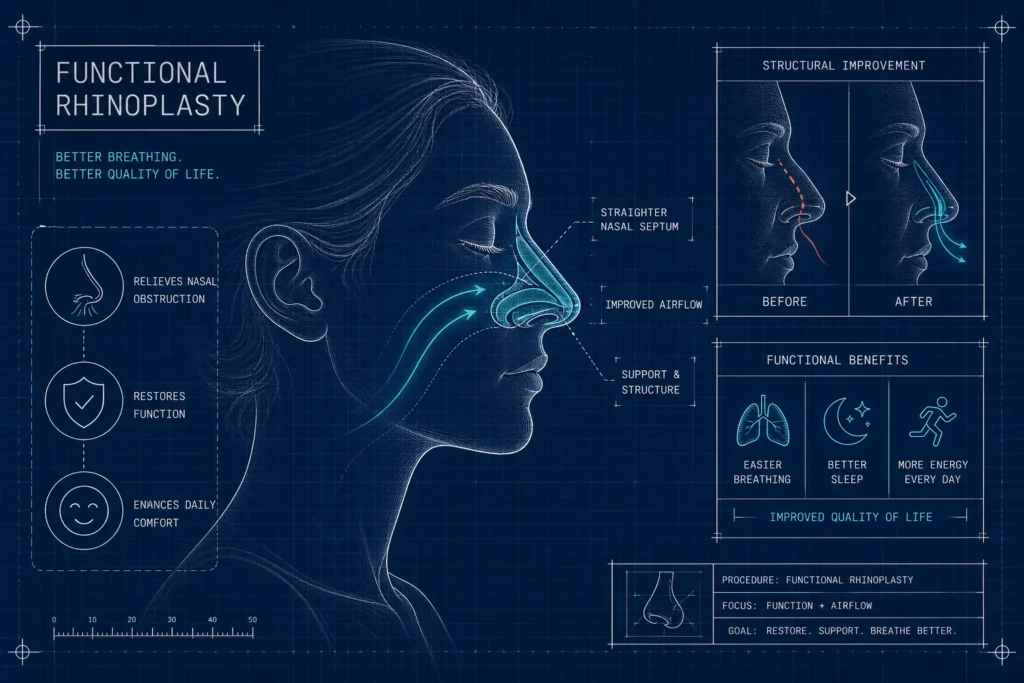
Persistent Breathing Problems
Rhinoplasty is evaluated not only in terms of appearance but also in terms of function.
After surgery:
- Unilateral blockage
- Persistent difficulty breathing
- A sensation of tightness inside the nose
- A significant problem with airflow
If this is the case, an assessment may be necessary.
The ENT approach is particularly important here.
Drooping Nose Tip
The tip of the nose can change over time.
In some patients:
- Tilting downward while smiling
- A feeling of low self-esteem
- Change in the nasolabial angle
It may attract attention.
However, in the first few months, edema may lead to an incorrect assessment.
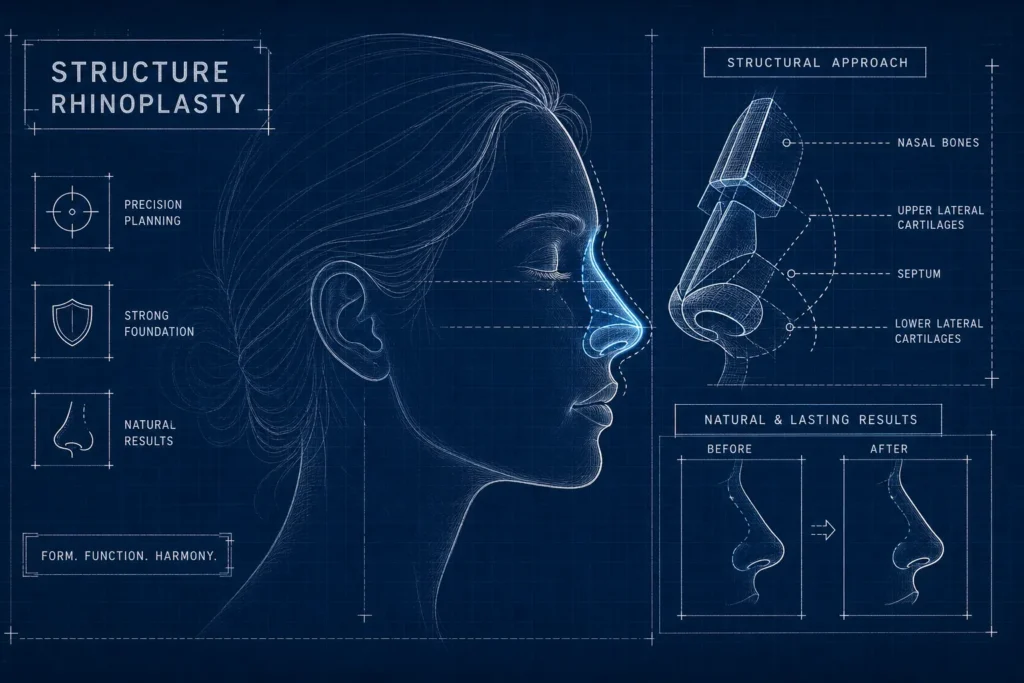
Depression or Irregularity on the Bridge of the Nose
In some people:
- Profile Fluctuation
- Indentation on the bridge of the nose
- Irregularity in the bone structure
can be noticed.
Some minor irregularities may change as recovery progresses.
Noticeable Asymmetry in the Nostrils
Minor differences may be observed in the early stages.
However, once the recovery is complete:
- A noticeable difference in size
- Shape mismatch
- A striking inequality
can be evaluated
Psychological Perception May Also Play a Role
After rhinoplasty, people may begin to examine their faces more closely.
Small details that went unnoticed before:
- It may feel as if it has grown
- can constantly attract attention
- may cause anxiety
Comparing photos constantly during the first few months can be misleading.
How Can You Tell the Difference Between Signs of a Failed Rhinoplasty and the Healing Process?
Not every change observed in the first few months after rhinoplasty indicates a failed procedure. In particular, it can be misleading to assess the nose’s final shape before the swelling has completely subsided.
In the first period:
- The nose looks more swollen in the morning
- A sensation of stiffness at the tip of the nose
- Minor asymmetries
- Perceptions of Different Appearances in Photographs
It may be a natural part of the healing process.
When evaluating the signs of a failed rhinoplasty, not only the appearance but also breathing function, changes over time, and the clinical examination should be considered together.
When Should Revision Rhinoplasty Be Considered?
The decision to undergo revision rhinoplasty is often not made right away.
Because:
- The swelling may still be present
- The tissues may not have settled yet
- The shape of the nose may continue to change
A thorough evaluation is important.
What Do Scientific Sources Say on This Topic?
Post-rhinoplasty evaluation is not based solely on the early appearance. Long-term results, the healing process, and functional assessments are all taken into account.
Scientific study on this topic:
PubMed
Result
Signs of a failed rhinoplasty are not always apparent immediately after surgery. Swelling or minor differences observed in the early stages are often a natural part of the healing process.
Time and regular follow-up are important for the final evaluation.
When can you tell if a rhinoplasty has failed?
Changes observed in the first few weeks are often due to edema. It may take some time to reach a final assessment.
Is it normal for the nose to look crooked after surgery?
Temporary asymmetries may occur in the early stages due to edema.
Does a drooping tip of the nose mean the surgery was unsuccessful?
Not in every case. The evaluation should be conducted after the recovery process is complete.
Is it normal to have trouble breathing?
It may be due to swelling in the early stages. Problems that persist for a long time should be evaluated.
How long should I wait before having revision rhinoplasty?
This timeframe may vary from person to person and should be assessed by a doctor.