Deciding on a nose job, Turkey vs. the USA, is not just a cost question. Rhinoplasty in the United States can easily run $15,000 or more once you add surgeon fees, facility costs, anesthesia, and post-op care. Turkey can offer savings of 60 to 75 percent at accredited clinics, and that price difference is drawing growing numbers of American patients to research their options abroad in 2026. The hesitation is equally real: How do you verify a surgeon from 6,000 miles away? What happens if something goes wrong after you fly home?
This article gives you actual numbers, verifiable credential benchmarks, and a concrete checklist you can act on. For patients choosing the right clinic, the quality gap between Turkey and the U.S. is smaller than most people assume. The key phrase there is “the right clinic,” and by the end of this article, you’ll know exactly how to find one.
What rhinoplasty actually costs: Turkey vs. the USA in 2026
Breaking down Turkey’s all-inclusive pricing
Primary rhinoplasty in Turkey in 2026 runs $3,500 to $6,500 for surgery alone. All-inclusive packages, which are what most international patients book, typically range from $4,500 to $7,500. That price covers surgeon fees, anesthesia, clinic or hospital charges, three to six nights in a four- or five-star hotel, VIP airport and ground transfers, initial medications, and a dedicated multilingual patient coordinator. Premium packages with five-star accommodation and extended aftercare can reach $6,500 to $8,000. (These ranges reflect market price surveys of internationally accredited Turkish clinics and should be confirmed directly with any provider before booking, as pricing can shift with exchange rates.)
One important clarification: international flights are almost never included. If you see offers below $3,000, read the fine print carefully. Sub-$3,000 packages routinely strip out aftercare, use lower-tier facilities, or reflect clinics that prioritize volume over outcomes. A realistic, safe, well-supported surgery from an experienced surgeon sits in the $4,000 to $6,500 range for the full package.
What U.S. pricing really covers (and what it doesn’t)
The American Society of Plastic Surgeons (ASPS) reports an average surgeon fee of $7,637 for rhinoplasty, but that figure represents the surgeon’s fee only. Add facility costs ($1,000 to $4,000), anesthesia ($600 to $2,500), and post-operative visits, and the realistic total for a primary rhinoplasty at an established U.S. practice lands between $12,000 and $18,000. High-end facial plastic surgery centers in major cities regularly exceed that range.
When you compare sticker prices, you need an apples-to-apples structure. The Turkish all-inclusive package bundles everything. The U.S. quote usually reflects the surgeon’s fee as a starting point, with additional line items added separately. Build the full U.S. cost before you put the two numbers side by side.
Why the cost gap exists
Turkey’s lower costs reflect structural economic realities. A weaker currency relative to the dollar and a government-supported medical tourism infrastructure actively incentivize clinics to serve international patients, and neither factor requires a shortcut on care quality. Cost differences between countries do not necessarily indicate lower surgical standards; they reflect what it costs to run an operating environment, not what goes into it. That distinction matters when you’re evaluating whether the savings are legitimate.
How to evaluate surgeon credentials and clinic safety in both countries
What to verify for a Turkish rhinoplasty surgeon
Three items are non-negotiable. First, confirm the surgeon holds a Turkish Ministry of Health Specialization Certificate, which verifies formal specialist training. Second, confirm the clinic holds an International Health Tourism Authorization Certificate, legally mandatory for any facility treating foreign patients in Turkey, and verifiable through the USHAŞ database. Third, confirm TPRECD membership (Turkish Society of Plastic, Reconstructive and Aesthetic Surgeons), which represents adherence to national ethical standards.
Beyond those three, look for voluntary international credentials: EBOPRAS (European Board of Plastic, Reconstructive and Aesthetic Surgery) and ISAPS (International Society of Aesthetic Plastic Surgery) membership signal global peer recognition. Neither is required, but both are meaningful. You can verify EBOPRAS status at ebopras.org and ISAPS at isaps.org. For a practical walk-through on how to verify your Turkish surgeon’s credentials online, see this step-by-step verification guide.
U.S. board certification and what it actually signals
For U.S. surgeons, the primary benchmark is ABMS board certification. For rhinoplasty specifically, the relevant boards are the American Board of Plastic Surgery and the American Board of Facial Plastic and Reconstructive Surgery. “Board-certified surgeon” alone doesn’t guarantee rhinoplasty specialization, a surgeon can be board-certified in a different specialty entirely. Verify the specific board at the ABMS Certification Matters website or at absurgery.org, confirm state licensure through the relevant state medical board registry, and check that training was ACGME-accredited.
JCI accreditation as a cross-border quality benchmark
Joint Commission International accreditation is widely regarded as one of the most reliable cross-border safety benchmarks available to international patients, covering infection control, patient safety protocols, surgical team qualifications, and facility management. Critically, JCI applies to both top Turkish hospitals and U.S. facilities, making it a neutral, verifiable standard regardless of geography. Confirm current JCI status directly on the JCI website before booking, accreditation can and does lapse.
Rhinoplasty safety, Turkey vs. the USA: what the data actually says
Complication and revision rates: reading the research honestly
No peer-reviewed study directly compares rhinoplasty complication rates between Turkey and the United States head-to-head. The available evidence reports general global rates across accredited facilities. An analysis published in the Aesthetic Surgery Journal found an overall complication rate of approximately 0.7 percent (hematoma at 0.2 percent, infection at 0.2 percent) and a revision rate of 5 to 15 percent across JCI-accredited facilities. The ASPS acknowledges a U.S. revision rate as high as 15 percent, consistent with that global range.
These numbers apply to accredited clinics. The picture changes significantly for unaccredited high-volume operations, where complication risks rise and follow-up is inconsistent. A U.S. study of cosmetic surgical tourism complications found that roughly 51 percent of returning patients presented with infections, and more than a third required hospitalization. That data covers patients who traveled abroad to multiple destinations and does not isolate outcomes by country or clinic accreditation level, meaning it reflects a broad, unvetted patient pool rather than the accredited clinic tier. The American Society of Plastic Surgeons has explicitly warned that plastic surgery abroad can lead to severe complications after returning to the U.S. The distinction is critical when interpreting these figures.
Aesthetic outcomes and ethnic rhinoplasty
For American patients with Middle Eastern, Turkish, Persian, or South Asian features, ethnic rhinoplasty expertise is a genuine differentiator. Turkish rhinoplasty surgeons work with these anatomy types at high volume, addressing the specific nasal tip projection, dorsal contours, and skin thickness common to these backgrounds. Many U.S. general plastic surgeons do not see the same case mix. That accumulated experience directly affects how natural the outcome looks.
Ethnic rhinoplasty is a subspecialty, not a standard procedure with a different label. For ethnicity-sensitive work, a surgeon who regularly operates on your anatomy type, regardless of geography, will typically deliver more refined, natural-looking results than one who treats it as an occasional case variation. Volume and familiarity with anatomy type matter more than geography when choosing a surgeon for this work.
Functional results: breathing improvement alongside cosmetic change
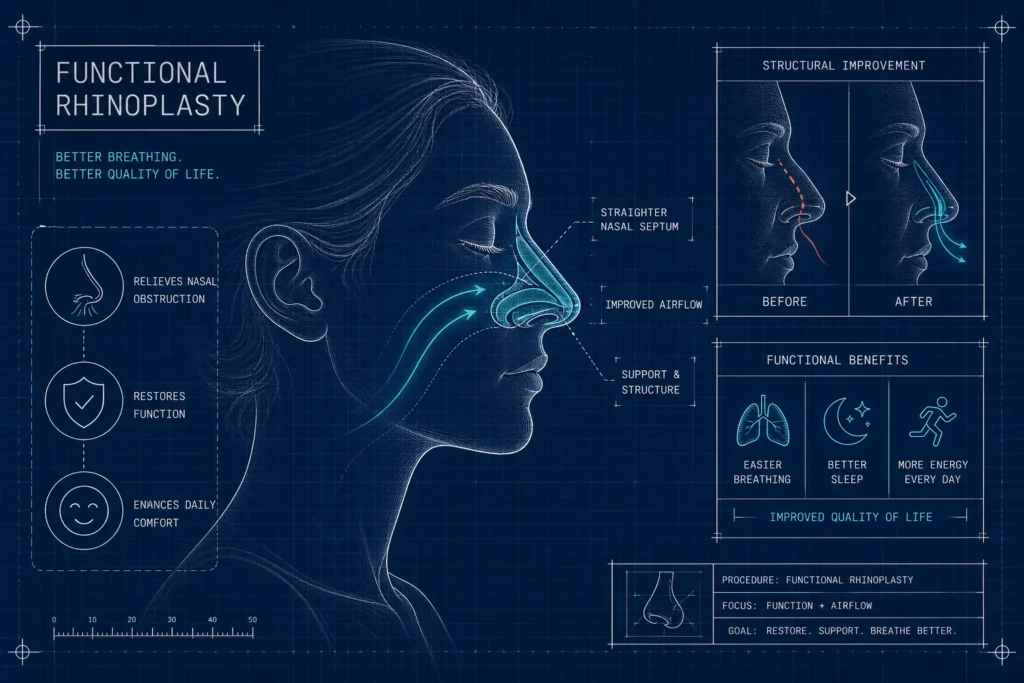
ENT-trained rhinoplasty surgeons carry a structural advantage when functional outcomes are a priority. Their training covers nasal airway dynamics, septum deviation, turbinate hypertrophy, and nasal valve collapse in depth that general plastic surgeons typically don’t match. According to ASPS procedure data, ENTs performed 71 percent of rhinoplasty procedures in recent years and report lower complication rates and superior functional outcomes compared to general plastic surgeons for this procedure. When an ENT-trained surgeon performs your cosmetic rhinoplasty, breathing improvement isn’t a secondary afterthought, it’s addressed simultaneously, eliminating the need for two separate procedures and two recoveries. For more on the functional aspects and when a functional rhinoplasty is indicated, see what is functional rhinoplasty.
The follow-up reality after you fly home
Turkey’s in-country recovery protocol for international patients
Reputable Turkish clinics build their recovery pathway around your departure date. The standard protocol involves a seven- to ten-day in-country stay with daily medical check-ins, nurse follow-ups at the hotel, and stitch removal completed before you board your flight home. A dedicated patient coordinator manages transport, medications, and scheduling throughout. This is fundamentally different from the U.S. model, where early recovery is self-managed at home with brief scheduled clinic visits.
Remote follow-up and what reputable clinics actually provide
For post-departure care, WhatsApp-based support and teleconsultation are commonly offered at quality-focused Turkish clinics treating international patients. Top-tier clinics provide structured remote follow-up with direct access to both the surgeon and the coordinator after you return home. This significantly reduces the isolation that international patients sometimes feel in the weeks following surgery. When evaluating a clinic, ask specifically what remote support looks like after departure, not just during the in-country stay.
When complications arise at home: the honest risk
If a complication surfaces weeks after you return to the U.S., you face a genuine logistical challenge: fly back to Turkey or find a local surgeon willing to manage another doctor’s work. Neither option is simple. Plan for this before you book by identifying a local ENT or plastic surgeon at home who will serve as your follow-up contact, and confirm in writing what remote support your Turkish clinic provides for complications that emerge post-departure. This isn’t a reason to avoid Turkey, it’s a reason to plan carefully.
Why Op. Dr. Ergün Kürün’s clinic is a benchmark for U.S. patients comparing options
25 years of ENT-trained rhinoplasty expertise in Adana
Op. Dr. Ergün Kürün brings over 25 years of ENT surgical experience to every rhinoplasty he performs at his boutique clinic in Adana. His ENT background means cosmetic goals and breathing function are addressed in a single surgery, not traded off against each other. He participates actively in international surgical congresses, which means his technique reflects what is being taught and refined at the leading edge of the field globally.
Advanced techniques: Preservation, Structure, and Piezo rhinoplasty
Preservation Rhinoplasty uses tissue-sparing approaches that maintain the natural support structures of the nose, reducing recovery time and producing results that look unaltered rather than surgically recontoured.
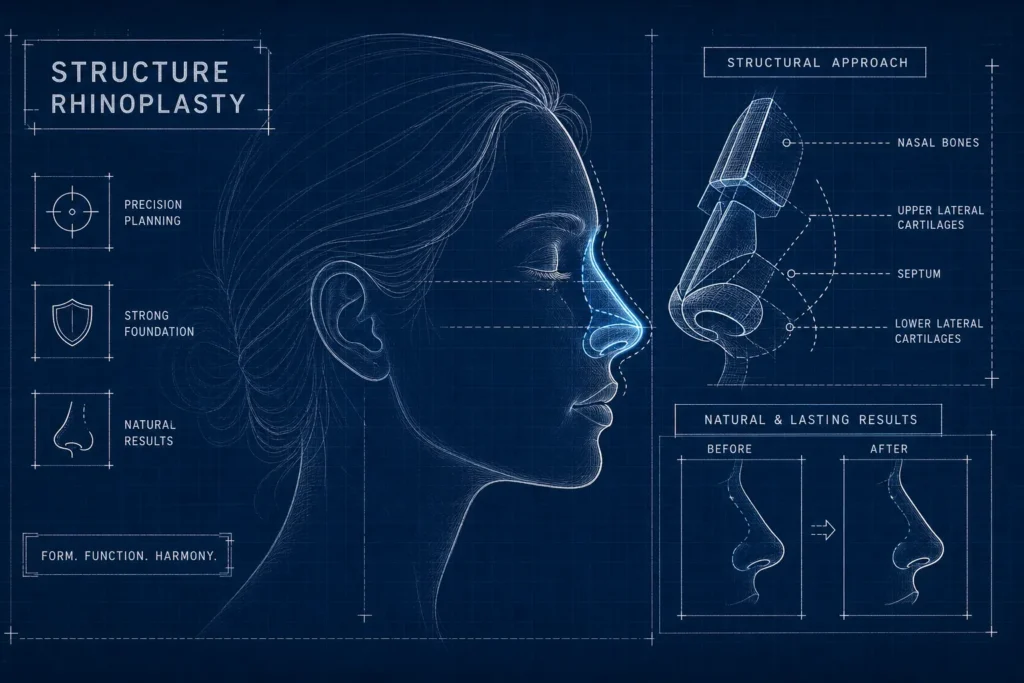
Structure Rhinoplasty builds long-lasting tip stability through precise cartilage grafting and suture techniques, particularly important for noses requiring significant tip refinement, where stability over time is as critical as the immediate aesthetic result.
Ultrasonic (Piezo) Rhinoplasty reshapes bone using ultrasonic vibrations that cut mineralized tissue without transmitting force to surrounding blood vessels and soft tissue. Clinical studies confirm significantly less bruising and swelling compared to traditional osteotomy, with most bruising resolving within seven to ten days rather than two to three weeks. These approaches represent the current direction of rhinoplasty at the highest level of the field, and they are standard practice at Op. Dr. Ergün Kürün’s clinic. For more on how ultrasonic bone shaping can reduce bruising, see this overview on piezo rhinoplasty and ultrasonic bone shaping.
English-language consultations and international patient logistics
The clinic offers a free initial consultation that includes an endoscopic nasal function evaluation, not a surface-level aesthetic discussion. Digital surgical planning with golden ratio facial analysis happens before any procedure, giving you a grounded preview of your potential outcome. The seven-day social recovery protocol is designed specifically with international patients in mind, and English-language support runs throughout consultation, surgery, and follow-up. This isn’t a clinic that adapted for international patients as an afterthought; the entire workflow is structured around them.
Your step-by-step checklist to vet any clinic before booking
Credential verification: the non-negotiable steps
- Verify the surgeon’s Ministry of Health Specialization Certificate (Turkey) or ABMS board certification (U.S.) through the official registry, not from documents the clinic provides directly.
- Confirm the clinic holds an International Health Tourism Authorization Certificate (Turkey) via the USHAŞ database, or is affiliated with an ACGME-accredited program (U.S.).
- Check JCI accreditation status directly on the JCI website and confirm it is current.
- Request before-and-after photos of the surgeon’s own rhinoplasty patients with anatomy similar to yours. Stock images are a red flag.
- Confirm the named surgeon personally performs the key surgical steps, not residents or unlicensed staff.
Questions to ask during your consultation
The quality of a consultation tells you a great deal about the quality of the surgery. Ask how many rhinoplasties the surgeon performs per year and what technique will be used for your specific anatomy and why. A surgeon who gives you a generic answer hasn’t actually analyzed your face. Ask directly whether the consultation is with the surgeon or a patient coordinator, whether cosmetic and functional concerns can be addressed simultaneously, and what the revision policy covers if you’re unsatisfied with the outcome.
For international patients, one question is non-negotiable: who manages complications after you return home, and what is the specific protocol? A clinic that can’t answer this clearly has not built its process for international patients.
Planning travel, recovery accommodations, and return-home care
Plan for a minimum of seven to ten days in-country before your return flight, with many surgeons recommending the full ten days as a buffer. Before you travel, identify a local ENT or facial plastic surgeon at home who will serve as your follow-up contact and is willing to manage a post-operative situation if needed. Confirm in writing the remote support your Turkish clinic provides after departure, including direct access to the surgeon and the process for emerging complications. These logistics take less than a week to arrange and significantly reduce your risk exposure.
Make an informed decision on your timeline
Choosing between rhinoplasty in Turkey and the U.S. is not purely a price decision. It’s a decision about aligning real cost savings with verifiable credentials, a structured follow-up plan, and a surgeon whose technique matches your anatomy and goals. The cost advantage at accredited Turkish clinics is well-documented, but it becomes a liability when the vetting isn’t done.
Op. Dr. Ergün Kürün’s clinic in Adana represents what a carefully chosen Turkish rhinoplasty provider looks like in practice: ENT-trained with 25 years of surgical experience, operating at the frontier of modern technique, and built specifically to serve international patients from consultation through remote follow-up.
Use the checklist above, book a free initial consultation, and make your decision based on verified information rather than marketing claims. When weighing a nose job in Turkey vs. the USA, the right surgery performed by the right surgeon, with a clear aftercare plan, delivers results that hold up, regardless of which country you choose.