Going through rhinoplasty once and ending up worse off is one of the most frustrating medical experiences a person can face. You trusted a surgeon, paid a significant sum, endured the recovery, and now you’re looking in the mirror at a nose that doesn’t breathe right, looks operated on, or simply doesn’t match what you were promised. The emotional weight of that is real, and it doesn’t get lighter by pretending the question away.
So you’ve started looking at Turkey. Maybe you’ve seen before-and-after results that impressed you, or you’ve heard that Turkish surgeons handle revision cases that U.S. surgeons won’t touch. The cost gap is hard to ignore too. But you’re also cautious, because you’ve already been burned once, and you’re not interested in making the same mistake twice on a different continent.
The honest answer is: yes, a qualified Turkish surgeon can fix a botched nose job done in America. But the word “qualified” carries real weight, especially for revision work. This article walks you through what makes revision rhinoplasty technically demanding, what it actually costs in 2026, how to vet a surgeon properly, and what legal protections you have if things go wrong. The profile worth searching for combines deep structural expertise, digital pre-surgical planning, and a practice built around cases that demand precision over volume. Surgeons like Op. Dr. Ergün Kürün, an ENT-trained revision specialist based in Adana, represent exactly that approach.
Can a surgeon in Turkey fix a botched nose job done in America?
What separates a revision specialist from a general rhinoplasty surgeon
Not every surgeon who performs primary rhinoplasty is qualified to handle revisions. Revision work demands a fundamentally different skill set: the ability to read and work around scar tissue, source autologous cartilage from the rib or ear when the original supply has been depleted, and reconstruct nasal architecture that someone else altered. Synthetic implants are rarely the right answer in these cases, durability and biological compatibility require cartilage grafting, a technique that takes years to master.
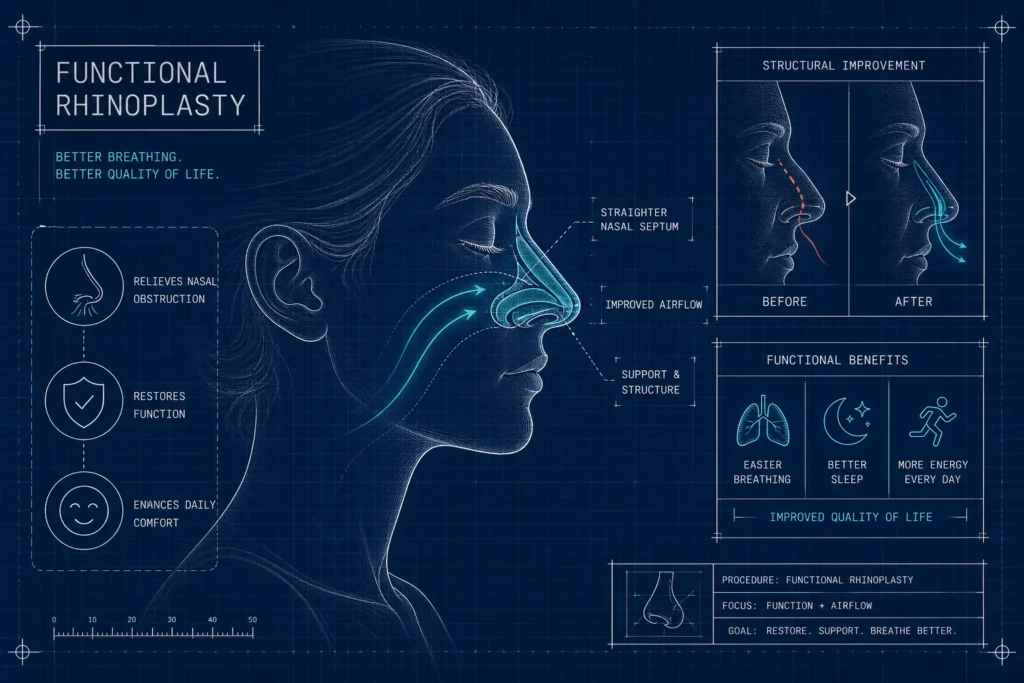
ENT-trained surgeons carry a specific advantage in revision cases because breathing obstruction is frequently part of the problem, not just a cosmetic complaint. When a first surgery created or worsened a deviated septum, collapsed a nasal valve, or disrupted turbinate function, you need a surgeon who treats those issues as core anatomy rather than secondary concerns. Functional reconstruction and aesthetic refinement aren’t two separate goals; they’re the same surgery done correctly.
Why Turkey has become a destination for complex American revision patients
Turkey has produced surgeons who present at international rhinoplasty congresses, publish research on nasal reconstruction techniques, and train other surgeons in advanced methods. That academic and clinical footprint is meaningful, because it reflects genuine peer accountability rather than self-reported credentials. Many boutique clinics in Turkey offer a structural advantage that large U.S. hospital systems often can’t match: direct, hands-on surgeon involvement at every stage of care, with less delegation to rotating staff or residents.
Success rates with experienced Turkish revision specialists range from 85% to over 95%, depending on case complexity and the surgeon’s specific expertise. Those numbers come from clinic-reported satisfaction data rather than controlled studies, so they should be read as directional rather than definitive. They suggest that skilled secondary rhinoplasty in Turkey, what’s known in the field as medical tourism rhinoplasty for revision patients, can produce outcomes comparable to top-tier U.S. providers, at a fraction of the cost. For a curated directory of Turkish revision specialists and international patient reviews, platforms such as Bookimed’s revision rhinoplasty listings in Turkey can be a useful starting point when building your short list.
What makes revision rhinoplasty harder than your first surgery
The physical obstacles a revision surgeon inherits
A surgeon performing your revision isn’t starting from a blank canvas. They’re working through scar tissue that has distorted normal anatomy, operating on a nasal structure with potentially depleted cartilage, and navigating altered blood flow patterns that affect how tissue heals. Every one of those factors increases operative complexity and extends recovery, this is not a touchup, and the surgical difficulty often equals or exceeds primary rhinoplasty.
The practical consequence is that revision cases require more planning time, more surgical time, and a surgeon with a specific case portfolio in structural reconstruction. A surgeon who performs high-volume primary rhinoplasty does not automatically have that experience. Verify revision-specific work before you ever book a consultation.
Why timing and patience matter before booking
Most experienced surgeons require patients to wait at least 12 months after their primary rhinoplasty before attempting revision, because residual swelling can make the true outcome impossible to assess before that point. The nose you’re looking at six months post-op is not the nose you’ll have at 14 months. Rushing a revision before tissues have fully settled is one of the most common and costly mistakes revision patients make.
A qualified surgeon will insist on this timeline regardless of how unhappy you feel right now. If a surgeon agrees to revise your nose at four or six months post-op without a compelling functional reason, treat that as a red flag. Patience is part of the protocol, not an obstacle to it.
Revision rhinoplasty costs: Turkey vs. the U.S. in 2026
What the numbers actually look like
Revision rhinoplasty in Turkey typically runs $4,500 to $9,000 for experienced specialists in 2026, with complex rib cartilage reconstruction cases reaching higher. In the U.S., the same procedure costs $15,000 to $40,000, with $18,000 to $25,000 being the common range for skilled revision surgeons. That gap represents 60 to 75% in savings before you account for bundled services.
The comparison holds even after factoring in international travel. Round-trip airfare from the U.S. to Turkey varies considerably based on departure city, season, and booking window, budget anywhere from $800 to $2,500 depending on those variables. Adding that to a full Turkish package still puts total all-in costs well below the U.S. baseline for comparable surgical expertise. For clinic-level cost breakdowns and examples of package components, see a clinic cost reference such as Doku Clinic’s rhinoplasty cost overview, which illustrates how bundled pricing tends to work for international patients.
What Turkish all-inclusive packages cover (and what they don’t)
Reputable Turkish clinics structure revision packages to include surgery, anesthesia, hospital stay, accommodation for 7 to 10 days, airport transfers, prescribed medications, and initial post-operative follow-ups. International flights are the patient’s expense. One category that most packages do not cover is follow-up care after you return home, which should be budgeted separately.
Complex cases involving rib cartilage harvest can push costs toward $10,000 to $15,000 all-in, including flights. For straightforward revision work, the $7,500 to $11,500 range is a realistic planning figure. Either way, the savings over equivalent U.S. care remain substantial. For examples of what reputable Turkish revision clinics list as included services, clinics such as Gediz Serin’s revision rhinoplasty overview provide concrete package examples that help with budgeting and expectation setting.
The surgeon credentials checklist you can’t skip
Board certifications, international memberships, and facility standards
For revision cases specifically, these credentials are the minimum baseline before you agree to a consultation. Require Turkish Ministry of Health certification and TSPRAS (Turkish Society of Plastic, Reconstructive, and Aesthetic Surgery) board certification. For internationally validated standards, look for EBOPRAS (European Board of Plastic Reconstructive and Aesthetic Surgery) credentials or ISAPS (International Society of Aesthetic Plastic Surgery) membership. The clinic or hospital facility should hold JCI (Joint Commission International) accreditation.
These aren’t nice-to-haves. Together, they put a Turkish surgeon in the same quality tier as accredited U.S. providers. A surgeon missing multiple key credentials warrants additional scrutiny, verify the specifics through the certifying bodies directly before committing to a procedure as technically demanding as revision rhinoplasty.
How to evaluate revision-specific experience before committing
Board certification alone doesn’t confirm revision expertise. Ask to see a portfolio of before-and-after photos for patients with similar revision needs, specifically cases involving scar tissue management, cartilage grafting, or breathing restoration. Generic primary rhinoplasty results are not useful evidence for a revision case evaluation.
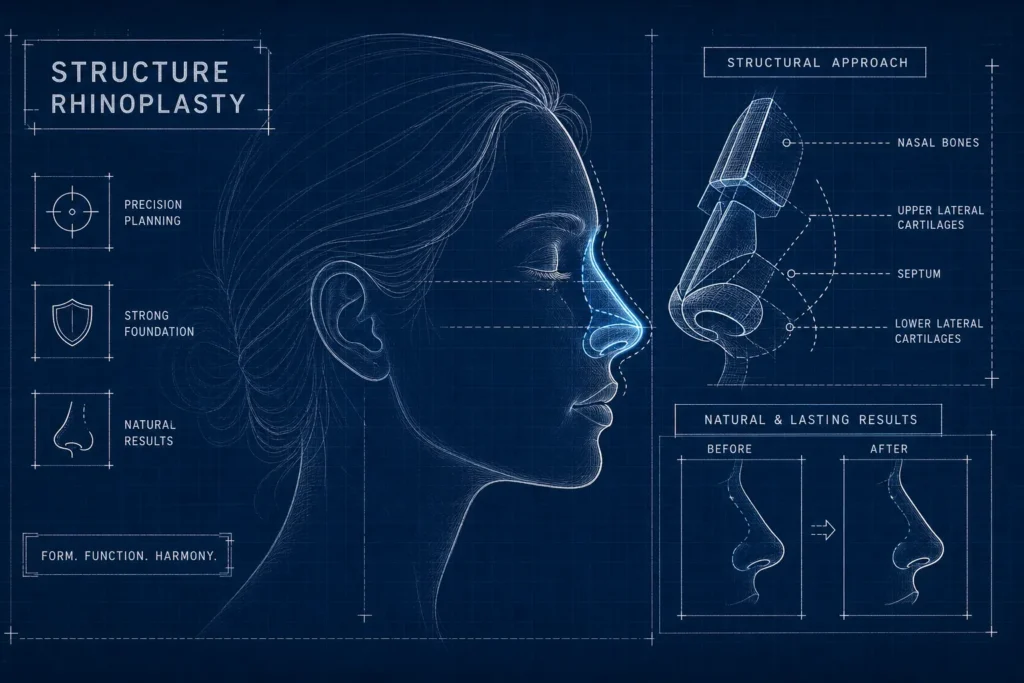
Look for academic indicators as well: published research on nasal reconstruction, participation in surgical congresses, or active involvement in training other surgeons. A surgeon who teaches revision technique publicly is demonstrating mastery, not just volume. Op. Dr. Ergün Kürün applies this approach, combining academic surgical engagement with a boutique practice model where every case receives direct, personalized attention. If you want to understand the structural principles that many revision specialists emphasize, review materials on structural rhinoplasty as a comparative framework for durability and function.
Risks, complications, and how follow-up care works from home
The complications that catch medical tourists off guard
Infections are the most frequently reported complication in surgical tourism studies, with some cases involving drug-resistant bacteria including MRSA and Mycobacterium strains. Long-haul flights after surgery carry a documented deep vein thrombosis (DVT) risk that patients consistently underestimate. Wound dehiscence and delayed healing are also reported at rates around 7% in broader medical tourism studies, note that this figure covers cosmetic procedures generally, not revision rhinoplasty specifically.
These risks don’t make Turkey the wrong choice, but they do require specific precautions. Fly with compression garments. Stay in Turkey for the full post-operative window, which is 7 to 10 days at minimum. Ensure your surgeon provides a clear written protocol for managing complications remotely after you return home. A reputable clinic will build that into the package; if a clinic doesn’t discuss remote aftercare proactively, that’s a problem.
What post-op care looks like once you’re back in the U.S.
This is the part most patients don’t think about until they’re sitting at home with a question and no one to call. Local U.S. surgeons frequently decline to manage complications from procedures performed abroad. That means your Turkish clinic becomes your primary point of contact. Reputable clinics handle this through scheduled video follow-ups, written care protocols, and designated English-speaking staff who manage international patient communication.
Verify before you book that your clinic has a structured aftercare system for international patients, not just a general phone number. Also confirm whether your U.S. health insurance will cover domestic treatment of any complications, because standard travel insurance typically excludes elective cosmetic procedures. Knowing the coverage gap in advance lets you plan for it, rather than discover it under stress.
Your legal protections and what to do before you book
How Turkish consumer law protects U.S. patients pursuing revision nose surgery in Turkey
Turkish law classifies cosmetic surgery under contract law, which means a surgeon can be held liable for negligence and for failing to deliver the agreed outcome. Mandatory mediation precedes any lawsuit, and cases are heard in Consumer Courts. Patients can file from their U.S. residence without returning to Turkey by appointing a Power of Attorney.
The statute of limitations runs 5 years for aesthetic procedure claims in private clinics, with a 2-year window from the date of discovered harm for specific malpractice claims and a 10-year absolute limit from the procedure date. Compensation available under Turkish law includes corrective surgery costs, travel expenses, loss of income, and emotional distress damages, a broader scope of recovery than many patients anticipate when considering a claim abroad. For a practical legal overview aimed at patients, see When cosmetic surgery in Türkiye goes wrong: your rights, claims, and path to justice.
The evidence you must preserve before, during, and after surgery
Collect and secure the following before any problem arises, because reconstructing this documentation after the fact is far harder:
- All pre-operative consultation records and digital planning materials
- Signed consent forms in a language you fully understood
- Before-and-after photos taken at the clinic
- All communication records including WhatsApp, email, and Instagram threads (delete nothing)
- Payment receipts and invoices
- An independent medical evaluation from a U.S.-based surgeon both before travel and upon return
Patients have a statutory right under Turkish law to request their complete medical file. Exercise that right before you leave the clinic. Having complete documentation on hand protects you whether you’re managing a minor complication or pursuing formal legal action.
Making the right decision for your specific case
Can a surgeon in Turkey fix a botched nose job done in America? For the right patient working with the right surgeon, the answer is yes. The cost advantage is substantial and well-documented. The legal protections are more robust than most patients expect. And the technical expertise at the upper tier of Turkish revision rhinoplasty, built through academic engagement, international congresses, and specialist-focused practice, is internationally recognized. The risk, as with any surgery abroad, is choosing poorly, and the consequences of a poor choice in revision rhinoplasty are compounded by the fact that each additional surgery makes the next one harder.
The decision framework is straightforward, even if applying it takes effort. Confirm credentials against the checklist above. Verify revision-specific experience through case portfolios and academic indicators. Understand the follow-up logistics before you book, not after you land. Preserve your documentation from day one. Approach this process with the same rigor you would apply to vetting any surgeon in the U.S., because the quality threshold doesn’t lower because you’re traveling. For a concise guide on warning signs and early indicators that a revision might be necessary, consult the resource on 9 early signs that may indicate the need for revision rhinoplasty.
If you’re evaluating whether revision rhinoplasty in Turkey is realistic for your case, a teleconsultation with Op. Dr. Ergün Kürün carries no financial commitment but gives you direct access to a surgeon with extensive experience in both revision and functional rhinoplasty. That conversation lets you assess surgical thinking, ask case-specific questions, and determine whether the expertise matches your needs, all before committing to any travel or financial decision. If you prefer German-language materials on warning signs, there’s an available reference titled 9 warning signs that may indicate the need for revision rhinoplasty (German) that some patients find helpful when preparing questions for a teleconsultation.
Can a Turkish surgeon fix a botched nose job done in America?
Yes — the article says a qualified Turkish surgeon can fix a botched U.S. rhinoplasty, but qualification matters a great deal. Revision work requires surgeons with specific structural expertise and experience in complex reconstructions rather than general primary-rhinoplasty skills.
What makes revision rhinoplasty more difficult than a first-time nose job?
Revision rhinoplasty involves reading and working around scar tissue, sourcing autologous cartilage (often from the rib or ear) when previous grafts are depleted, and reconstructing nasal architecture altered by a prior surgeon. The article emphasizes that successful revision combines functional reconstruction and aesthetic refinement as a single, technically demanding procedure.
How should I vet a Turkish surgeon for a revision nose job?
Look for ENT-trained surgeons or those who specialize in revision rhinoplasty, evidence of peer-reviewed research or international presentations, and clinics that emphasize surgeon-led care and digital pre-surgical planning. The article also recommends checking international patient reviews and curated directories such as Bookimed to build a vetted short list.
Why are U.S. patients traveling to Turkey for complex revision cases?
Turkey has surgeons who present at international rhinoplasty congresses, publish on reconstruction techniques, and train other surgeons, creating an academic and clinical footprint. Boutique Turkish clinics often offer hands-on surgeon involvement, and the article notes that skilled revision care there can achieve comparable outcomes to top U.S. providers at a fraction of the cost.
Are synthetic implants a good solution for revision rhinoplasty?
The article states synthetic implants are rarely the right answer for revision cases. Durability and biological compatibility usually require autologous cartilage grafting, a technique that takes years to master and is preferred for complex reconstructions.
What success rates can patients expect from Turkish revision specialists?
Clinic-reported success or satisfaction rates for experienced Turkish revision specialists range from about 85% to over 95%, depending on case complexity and surgeon expertise. The article cautions these figures come from clinic reports rather than controlled studies and should be read as directional rather than definitive.
What legal protections exist if something goes wrong after surgery in Turkey?
The article says legal protections are an important consideration but can vary by jurisdiction and clinic, so you should review contracts, malpractice policies, and international patient terms before committing. It advises researching legal recourse and protections as part of the pre-surgical vetting process.