You’ve found three Turkish rhinoplasty surgeons online. All three have polished websites, impressive Instagram galleries, and glowing testimonials. The pricing looks comparable, the before/after photos look good, and each surgeon’s bio uses confident language about “advanced techniques” and “natural results.” The problem: you have no way to tell, from marketing materials alone, whether any of them are actually qualified. That’s exactly why credential-checking exists. It’s not excessive caution, it’s the only reliable way to separate skilled surgeons from skilled marketers. So what credentials should you look for in a Turkish rhinoplasty surgeon? That’s precisely what this guide answers.
The standard worth benchmarking against is straightforward: a qualified surgeon publishes verifiable credentials upfront, not buried in footnotes. That level of transparency is what every surgeon on your shortlist should offer before you ask. This article gives you the exact checklist to hold them to it.
What credentials should I look for in a Turkish rhinoplasty surgeon?
Turkish rhinoplasty surgeon qualifications fall into five verifiable categories: specialty background and board certification, operating facility accreditation, portfolio documentation standards, international congress participation, and patient review quality. Each layer can be independently confirmed. None requires you to take a clinic’s word for it. The sections below walk through each one in sequence.
Specialty background: why ENT training changes everything in rhinoplasty
Both ENT surgeons and plastic surgeons legally perform rhinoplasty in Turkey, but their training routes are fundamentally different. An ENT specialist spends years training on internal nasal anatomy: the septum, turbinates, nasal valves, and the structural mechanics that govern how you breathe. A plastic surgeon’s training centers on external form and tissue reshaping. Neither path is wrong, but the distinction matters enormously for what happens inside the operating room.
What ENT specialization adds to the rhinoplasty outcome
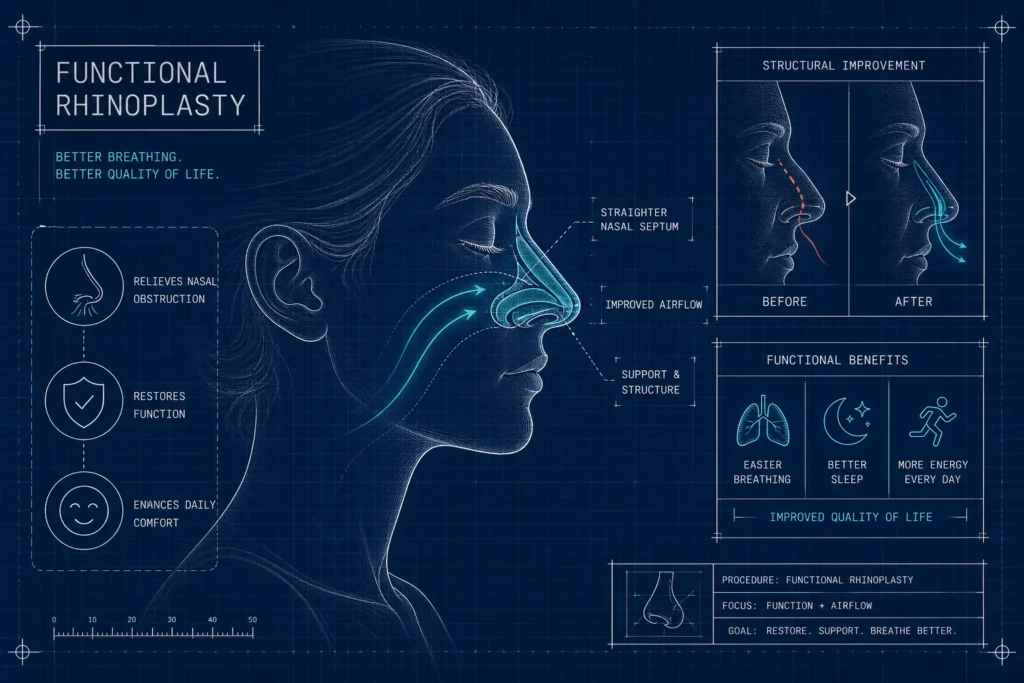
For patients who want both a refined appearance and improved breathing, an ENT-trained rhinoplasty surgeon can address both goals in a single operation. The functional and aesthetic objectives are handled simultaneously, one surgery, one recovery, and one set of risks instead of two procedures scheduled months apart. This integrated approach is a meaningful clinical advantage, not a marketing angle.
When plastic surgery training is sufficient for rhinoplasty
Plastic surgeons who subspecialize exclusively in rhinoplasty can develop equivalent skills. When a plastic surgeon has spent a decade focused solely on nasal surgery, that depth of subspecialization matters more than the original training track. What you’re looking for is depth of focus, not just the specialty label.
The one question to ask every clinic before going further
Ask directly: which specialty did the surgeon train in, and can they provide the corresponding board certificate? Then confirm the answer against the certificate itself. If the clinic deflects this question, that deflection is already informative. A straightforward answer with a verifiable document is the only satisfactory response.
Board certification and professional society membership you can actually verify
When evaluating credentials for a Turkish rhinoplasty surgeon, board certification is the foundation. It’s a verifiable credential with a specific issuing body and a searchable lookup tool. The phrase “board-certified” on a website means nothing without knowing which board issued it. For plastic surgeons in Turkey, the issuing body is the Turkish Society of Plastic, Reconstructive and Aesthetic Surgeons (TSPRAS), and their member directory is searchable at turkplasticsurgery.org. For ENT surgeons, the credential is the Turkish Board of Otorhinolaryngology certificate, issued through the Turkish Society of Otorhinolaryngology.
The two credential tracks: plastic surgery board vs. ENT otorhinolaryngology board
Additional international memberships signal globally validated standards beyond the national minimum. ISAPS membership indicates the surgeon has met the International Society of Aesthetic Plastic Surgery’s requirements. EBOPRAS certification means the European Board of Plastic Reconstructive and Aesthetic Surgery has reviewed and approved their credentials. These are meaningful additions to a surgeon’s profile, not decorative titles.
How to search official member directories step by step
The verification process takes three steps. First, ask the clinic for the surgeon’s board certificate name and the year it was issued. Second, navigate to the corresponding member directory and search by the surgeon’s full legal name. Third, confirm that the name, specialty, and certification year on the website match what the clinic provided. Discrepancies, even small ones, warrant a direct follow-up question.
Why “trained surgeon” on a website is not the same as board-certified
Clinics routinely use phrases like “trained surgeon,” “certified specialist,” and “highly qualified professional” in bios and marketing copy. None of these phrases correspond to a specific credential. Board certification has a named issuing body, an exam, and a verifiable record. If a surgeon’s bio cannot point you to a specific board and a searchable directory, you don’t have a credential; you have a claim.
Hospital accreditation and the health tourism authorization certificate
A qualified surgeon operating in an unaccredited facility creates real patient risk. Credential-checking has to include the operating environment, not just the surgeon’s individual qualifications. There is a three-tier framework worth knowing before you book.
JCI accreditation and what it confirms about a surgeon’s operating environment
Joint Commission International (JCI) accreditation is the global benchmark for hospital quality. Turkey has one of the largest concentrations of JCI-accredited hospitals in the world, the current count is listed in the JCI directory at jointcommissioninternational.org, which you can search directly to confirm any specific facility’s status. A surgeon with JCI hospital operating privileges has cleared that institution’s credentialing and hiring process, which filters out unqualified practitioners before patients ever encounter them.
The health tourism authorization certificate every international patient should demand
The Health Tourism Authorization Certificate, known in Turkey as the Sağlık Turizmi Yetki Belgesi, is a legal requirement for any Turkish clinic serving foreign patients. Clinics without this certificate are operating outside the official health tourism system, which removes regulatory oversight and legal protections. You can verify a clinic’s authorization status through the USHAŞ portal at healthturkiye.gov.tr by entering the clinic’s name or registration code.
How to cross-check TÜSKA and Ministry of Health licensing online
TÜSKA, Turkey’s Health Services Quality and Accreditation Institute, enforces sanitation standards, emergency response protocols, and staff licensing across public and private hospitals. Ministry of Health licensing is verifiable through saglik.gov.tr. Confirming all three layers, JCI accreditation, TÜSKA certification, and the Health Tourism Authorization Certificate, gives you the highest available assurance that the facility is properly regulated.
Reading a before/after portfolio with objective criteria
Most patients evaluate before/after photos aesthetically: does that nose look good? A trained eye reads them differently. The aesthetic question matters, but the structural indicators embedded in the portfolio tell you far more about surgical discipline and honest documentation.
Primary case volume vs. revision-heavy portfolios: what the ratio tells you
Look at the proportion of primary cases to revisions in the gallery. A surgeon performing mostly revision rhinoplasties is, by definition, correcting other surgeons’ mistakes rather than building a primary track record. Experienced surgeons with strong outcomes show predominantly primary cases across diverse face types, skin thicknesses, and ethnic backgrounds. Published surgical case series have documented primary case ratios of 90% or higher among experienced rhinoplasty surgeons with consistently strong outcomes, ask any surgeon on your shortlist for their own figure.
Consistency indicators that separate skilled documentation from curated marketing
Standardized photo documentation is a professional discipline, not just an aesthetic preference. Consistent lighting, identical camera angles, and uniform photo quality across dozens of patients signals a systematic clinical process. Two separate problems are worth watching for in a portfolio. First, photos where lighting, angle, or framing shifts dramatically between cases may indicate selective presentation rather than comprehensive documentation. Second, results that look nearly identical across patients with completely different facial structures raise a different concern: it can suggest the surgeon is applying a single aesthetic template rather than adapting to individual anatomy.
The revision rate question every patient should ask before booking
Peer-reviewed rhinoplasty literature commonly cites revision rates in the range of 5 to 15% across the general patient population, a range reflected in systematic reviews and large cohort studies. Experienced surgeons with high primary-case volume often report rates well below that range. Ask directly: “What percentage of your patients require any secondary procedure?” A surgeon who gives you a specific, honest number and acknowledges that outcomes are never guaranteed is more credible than one who claims a perfect record. Transparency about realistic outcomes is itself a credential.
International congress participation and advanced technique credentials
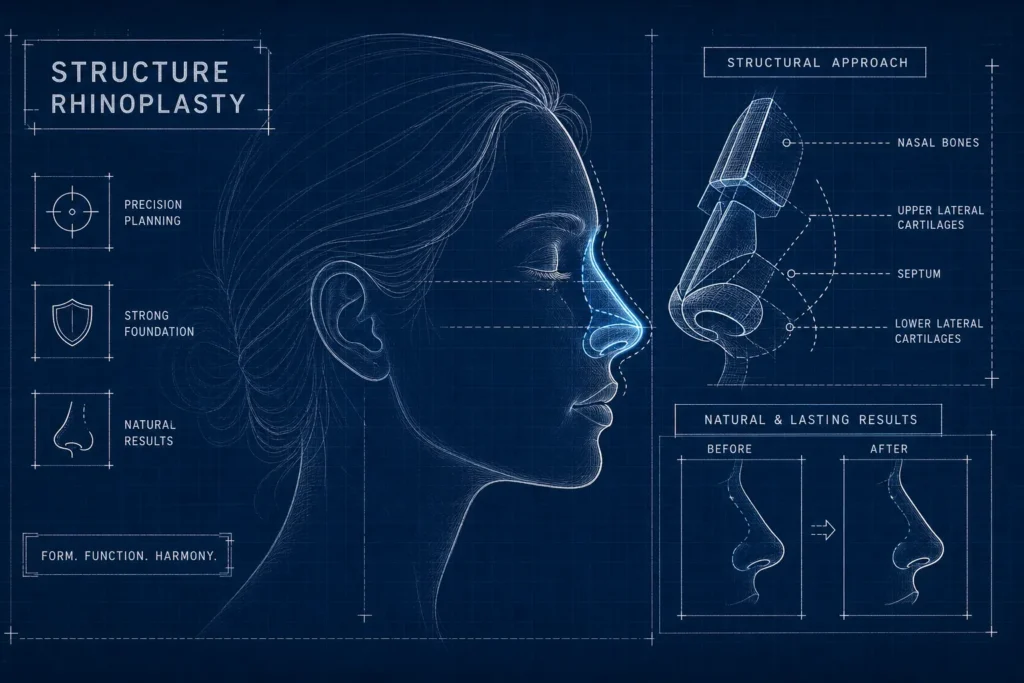
Board certification confirms that a surgeon met the standard at the time they were certified. International congress participation confirms they are still advancing. Rhinoplasty has changed dramatically in the last decade: Preservation Rhinoplasty, Structure Rhinoplasty, and Ultrasonic (Piezo) Rhinoplasty have fundamentally altered what outcomes are achievable and how quickly patients recover. A surgeon who trained 15 years ago and stopped engaging with the field is not the same practitioner as one who is actively applying current techniques.
Why a board certification alone doesn’t tell you what technique the surgeon uses today
Ask the clinic directly: has the surgeon presented at or attended international rhinoplasty congresses? Credible events include the Intercontinental Rhinoplasty Meeting, the ISAPS World Congress rhinoplasty sessions, the London Rhinoplasty Course at the Royal Society of Medicine, and Istanbul’s All in One Rhinoplasty and Face Congress. Surgeons who present at these events are recognized by peers as contributors to the field, not just practitioners within it.
The three rhinoplasty technique categories to ask about in your consultation
Before committing to a surgeon, confirm which techniques they currently use and what training informs their approach. The categories to ask about are Preservation Rhinoplasty (tissue-sparing, typically associated with faster recovery), Structure Rhinoplasty (cartilage support framework for long-term tip stability), and Ultrasonic or Piezo Rhinoplasty (precision bone reshaping with reduced bruising). A surgeon fluent across all three can tailor the approach to your anatomy rather than applying one method to every patient regardless of fit.
Using congress participation as a proxy for current surgical excellence
When evaluating what credentials to look for in a Turkish rhinoplasty surgeon, congress participation is one of the clearest indicators that a surgeon’s skills are current. Clinics that publish specific congress names, presentation topics, and technique training history make that verification easy. If a clinic cannot answer questions about technique training and congress participation, you don’t have enough information to evaluate them fairly, and that gap itself tells you something.
Patient reviews, red flags, and using the teleconsultation as a vetting tool
Patient reviews are the final verification layer, and the easiest to manipulate. Written reviews can be authored, aggregated, and selectively published. The evaluation standard has to be higher than reading star ratings.
What authentic patient reviews look like vs. manufactured social proof
Video testimonials and day-by-day recovery vlogs are significantly harder to fabricate than written reviews. Look for geographic diversity across patient backgrounds and consistent results across different ethnic facial structures, particularly if you are of Turkish, Middle Eastern, Persian, or South Asian descent. A surgeon whose gallery shows natural outcomes across varied ethnic features has demonstrated versatility, not just a single aesthetic preference applied universally.
Six red flags that should remove a surgeon from your shortlist immediately
Disqualify a surgeon immediately if any of the following are present:
- No verifiable board certificate from a named issuing body
- No hospital affiliation or operating facility information published
- Before/after photos showing near-identical post-op appearances across patients with different facial structures
- No Health Tourism Authorization Certificate for the clinic
- Inability to name the specific techniques used and their training basis
- No English-language consultation process available for international patients
How to turn a free teleconsultation into your most powerful vetting tool
The free consultation is not just a sales call; it’s a structured vetting opportunity. Use it to ask about:
- Board credentials by name and issuing body
- Technique training and specific congress participation
- Annual primary case volume
- Realistic revision rates for their patient population
A clinic that offers an initial consultation with endoscopic nasal function evaluation is signaling that it takes functional outcomes as seriously as cosmetic results, before any commitment is made. That kind of structured, clinically grounded intake process is worth noting when you compare surgeons on your shortlist.
Putting the checklist to work
Verifying Turkish rhinoplasty surgeon qualifications is more manageable than it sounds once you know exactly what to check and where. Work through the hierarchy in sequence:
- Specialty background and training track
- Board certification from a named, searchable issuing body
- Hospital accreditation and Health Tourism Authorization Certificate
- Portfolio depth and revision rate transparency
- Congress participation and current technique training
- Patient reviews and a direct teleconsultation
Patients who complete this process arrive at their consultation with clarity and a short list of surgeons who have actually cleared the standard. You’re not being difficult by asking for a board certificate name, a searchable directory entry, or a specific answer about technique training. None of those are marketing claims; each is a checklist item you can confirm directly. The surgeons worth working with will welcome every question.
If you’re beginning your search, Op. Dr. Ergün Kürün, Rinoplasti & Burun Estetiği Kliniği is designed to answer each of these questions directly: ENT board certification, verifiable congress participation records, current training across Preservation, Structure, and Ultrasonic rhinoplasty techniques, and a free initial consultation to start the process. Each of those points is verifiable, ask for documentation on any of them.
Further reading: Choosing the Right Doctor for Rhinoplasty, Adana Burun Estetiği, Who Is a Good Candidate for Rhinoplasty? | Dr. Ergün Kürün, M.D., and 11 important questions to ask before a rhinoplasty.
FAQ: Credentials for a Turkish rhinoplasty surgeon
What credentials should I look for in a Turkish rhinoplasty surgeon?
Look for board certification from TSPRAS (for plastic surgeons) or the Turkish Board of Otorhinolaryngology (for ENT surgeons), verifiable through official member directories. Confirm the surgeon holds operating privileges at a JCI-accredited or Ministry of Health-licensed facility, and that the clinic holds a valid Health Tourism Authorization Certificate. Beyond baseline licensing, check for international congress participation and current training in modern techniques such as Preservation, Structure, and Ultrasonic Rhinoplasty.
How do I verify a Turkish surgeon’s board certification?
Ask the clinic for the surgeon’s full legal name, the name of the issuing board, and the year of certification. Then search the corresponding member directory: turkplasticsurgery.org for TSPRAS members, or the Turkish Society of Otorhinolaryngology directory for ENT board holders. Confirm that the details match what the clinic provided.
Is JCI accreditation important for rhinoplasty in Turkey?
Yes. JCI accreditation means the facility has met international standards for patient safety, staff credentialing, infection control, and emergency protocols. A surgeon operating in a JCI-accredited hospital has cleared that institution’s own vetting process. You can confirm any hospital’s current JCI status directly through the JCI directory at jointcommissioninternational.org.
What is the Health Tourism Authorization Certificate and why does it matter?
The Sağlık Turizmi Yetki Belgesi is a Turkish government certificate required for any clinic legally serving international patients. Without it, the clinic operates outside the regulated health tourism system, removing key legal protections for foreign patients. Verify a clinic’s status through the USHAŞ portal at healthturkiye.gov.tr.
Should I choose an ENT surgeon or a plastic surgeon for rhinoplasty in Turkey?
Both are legally authorized to perform rhinoplasty in Turkey. An ENT-trained surgeon has deep background in internal nasal anatomy and can address both functional breathing issues and aesthetic goals in one procedure. A plastic surgeon with a dedicated rhinoplasty subspecialty can achieve equivalent results. The key factor is depth of rhinoplasty-specific experience, not the original training track alone.