Who is a good candidate for preservation rhinoplasty? That’s the question most patients should be asking, but rarely do. Instead, they ask “Is it better?” before asking “Is it right for me?” The answer depends entirely on what your nose looks like from the inside, not just the outside. Your dorsal contour, septal alignment, skin quality, and surgical history all determine whether this technique will deliver the outcome you’re imagining, or whether a different approach would serve you better.
Experienced surgeons, like Dr. Ergün Kürün at his rhinoplasty clinic in Adana, use a structured evaluation protocol to determine technique fit before any surgical plan is made. The criteria they assess aren’t arbitrary, they’re anatomically precise, evidence-based, and specific to how your nose is built. This guide walks you through every one of them so you can enter any consultation already knowing which questions to ask.
Who Is a Good Candidate for Preservation Rhinoplasty? The Anatomical Profile That Makes It Work
The dorsal hump: size matters, but so does shape
Both prominent and minor dorsal humps can qualify for preservation rhinoplasty, provided the goal is refinement rather than radical reshaping. The key factor isn’t the hump’s height alone; it’s whether your native dorsal aesthetic lines, specifically, well-defined brow-tip aesthetic lines with a clean inward curvature from the brow to the tip, are structurally worth preserving. When those lines are already elegant, preservation techniques can lower the hump while keeping everything that makes your nose look natural and proportionate to your face. If you’d like to learn about how this approach is used in practice, read more about Preservation Rhinoplasty, Adana Burun Estetiği 2026.
Why septum alignment is the first thing surgeons check
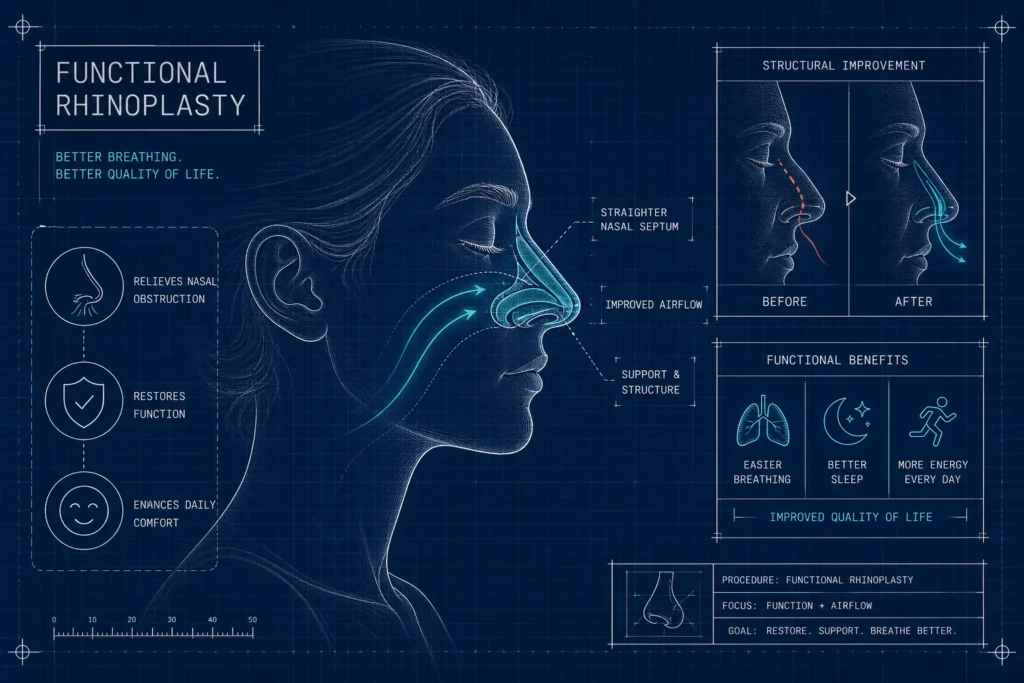
A straight septum is the primary structural requirement for preservation rhinoplasty. The technique relies on the caudal septal strut as its foundation, not as a rebuilding target. Minor deviations may be compatible with preservation in select cases, but when the septum is significantly deviated, that foundation becomes unreliable and the surgical approach shifts toward structural techniques that can correct and reinforce the internal framework. If you already know you have a deviated septum, that’s a critical piece of information to raise at your consultation before any technique decision is made.
Nasal bone shape: V-shaped profile versus S-shaped profile
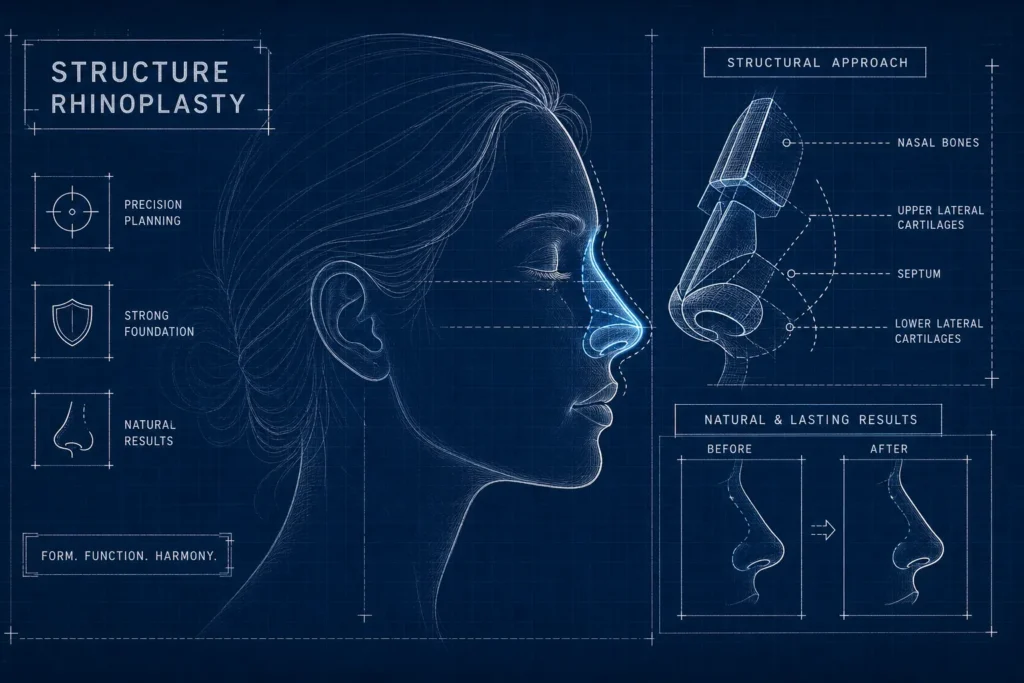
Nasal bone geometry is a meaningful predictor of preservation rhinoplasty outcomes. V-shaped deformity patterns, those with a favorable middle-vault configuration, tend to yield better results with dorsal preservation rhinoplasty than S-shaped patterns, where the kyphion (the most prominent point of the bony dorsum) may remain as a residual hump after preservation maneuvers because the bone isn’t fully reduced. Shorter nasal bones with a larger cartilaginous contribution to the hump are also associated with better preservation outcomes. This detail rarely appears in general rhinoplasty articles, but it’s exactly the anatomical nuance that separates a technically informed candidacy assessment from a surface-level evaluation. Surgeons who specialize in combining tissue-sparing philosophy with structural judgment often describe this balance; see the clinic’s approach to Structure-Preservation, Adana Burun Estetiği for an example. For a concise primer on the principles of dorsal preservation, many clinicians reference resources explaining what dorsal preservation rhinoplasty involves.
Skin Thickness and Tip Anatomy: The Factors Most Patients Overlook
Why thick skin works against preservation techniques
Skin elasticity is one of the most clinically relevant factors in determining who is suitable for preservation rhinoplasty, yet it’s one that patients almost never think to ask about. Good, pliable skin re-drapes smoothly after subtle structural changes, allowing the refined framework underneath to show through. Thick skin doesn’t respond the same way to conservative, tissue-sparing maneuvers, it can mask delicate refinements entirely. The clinical pinch test and palpation during your physical exam will identify this. Thick-skinned patients typically achieve more predictable results with structural rhinoplasty, which allows for more deliberate framework modification beneath the skin envelope and, in some cases, SMAS debulking to reduce tissue bulk at the tip. Note that thick skin is an observed anatomical variable; its distribution varies among individuals and should be assessed directly by your surgeon rather than assumed based on any background. See published analyses on how skin characteristics affect rhinoplasty outcomes in clinical series such as the review at clinical rhinoplasty studies on skin and outcomes.
Tip support and lower lateral cartilage health
Candidates for dorsal preservation rhinoplasty should have healthy lower lateral cartilages capable of maintaining tip support after dorsal work is completed. The technique isn’t designed to rebuild cartilage structures; it’s designed to refine what’s already architecturally sound. Patients seeking dramatic tip refinement, rather than hump reduction, may require structural grafting techniques that fall outside preservation’s scope. The distinction matters: preservation is a high-precision technique that performs best when the tip is a refinement target, not a reconstruction project.
The kyphion angle and what it predicts
The kyphion angle is a measurable anatomical predictor of surgical success that most patients have never heard of. Defined by the intersection of a tangent line to the bony hump and a tangent line to the rhinion, a lower, more favorable kyphion angle means the dorsum can be flattened through preservation maneuvers without leaving a residual bump. Larger angles increase the risk of incomplete correction and may require the surgeon to shift to a resection-based approach. The specific angle ranges that distinguish favorable from unfavorable profiles are assessed through cadaveric and radiologic studies your surgeon can reference. You can’t measure this yourself, but asking your surgeon about it during consultation is a direct way to gauge whether they’re evaluating your anatomy with this level of precision.
Why Your Surgical History Draws a Hard Line on Technique Choice
Primary rhinoplasty patients: the ideal candidacy scenario
Preservation rhinoplasty was designed for primary patients, people who have never had nasal surgery before. The technique relies on the integrity of native tissues, undisturbed ligaments, and an unaltered structural baseline. Primary patients with straight septa, good skin elasticity, and a naturally shaped dorsum represent the textbook preservation rhinoplasty candidate. Published cohort studies, including those by Tas et al. and Öztürk, consistently report 90, 92% patient satisfaction using the ROE questionnaire in this population. Revision rates across these cohorts range from 0% to 6.67%, which helps explain why the technique has attracted such significant clinical interest.
Why revision patients are generally excluded from preservation techniques
Previous rhinoplasty performed by another surgeon is listed as an absolute contraindication in the surgical literature, and the reason is anatomical, not arbitrary. Prior surgery disrupts the native architecture that preservation depends on: ligaments are cut, tissues are scarred, and the dorsum no longer exists in its original state. Revision patients with irregular dorsal lines, asymmetry, or tip instability require structural rhinoplasty, often with cartilage grafting to rebuild what was lost or damaged during the first procedure. If you’re researching your options after a prior nose job, preservation rhinoplasty is likely not the right technique for your anatomy.
When a hybrid approach becomes the surgical answer
Not every patient falls neatly into one category. Some patients have anatomy that’s largely suited to preservation, with one complicating factor (mild asymmetry, a low radix, or a partially deviated septum) that requires a structural element to resolve. Hybrid approaches that combine preservation and structural maneuvers exist and are performed by surgeons with command of both technique families. The critical point: a surgeon shouldn’t force a preservation technique simply because it’s currently the most discussed approach in aesthetic surgery. Technique selection should follow anatomy, not trend.
Contraindications: When Preservation Rhinoplasty Is the Wrong Call
Absolute contraindications every patient should know
Four findings in the surgical literature represent absolute exclusion criteria for preservation rhinoplasty. Understanding these helps you identify potential disqualifiers before your consultation:
- Previous rhinoplasty by another surgeon: Scar tissue and altered anatomy eliminate the structural foundation preservation depends on.
- Previous submucous resection of the nasal septum: The septal strut required for this technique no longer exists in its original form.
- Marked middle third asymmetry: This includes significant septal deviation, concave or convex dorsal lines, and inverted-V deformity, all of which require structural correction, not preservation.
- Saddle nose deformity requiring augmentation: When the dorsum needs volume added rather than reduced or maintained, preservation techniques cannot address the core problem.
Relative contraindications that complicate the decision
Relative contraindications don’t automatically eliminate you from consideration, but they shift the risk-benefit calculation significantly. Low radix height, pre-existing dorsal irregularities, a wide middle nasal vault, and an anterior nasal septal angle positioned lower than the rhinion all represent gray-zone findings. In these cases, a surgeon experienced in both technique families will weigh whether a preservation approach can be safely modified, whether a combined approach makes more sense, or whether structural rhinoplasty simply offers a more reliable path to your goals. These are the findings that require the most experienced surgical judgment and the frankest pre-surgical conversation.
What a Proper Candidacy Evaluation for Preservation Rhinoplasty Actually Looks Like
The physical exam: external and internal assessment
A thorough candidacy evaluation for preservation rhinoplasty covers both external and internal anatomy. External assessment includes dorsal aesthetic lines, projection, rotation, alar flare, symmetry, and nasal skin thickness through palpation and the clinical pinch test. The internal exam, specifically the septum, turbinate size, and nasal valve function, carries equal diagnostic weight. Most patients only think about what the surgeon will see from the outside. The inside tells an equally important story about whether preservation techniques are structurally feasible.
Endoscopic evaluation and imaging
An endoscopic nasal evaluation allows surgeons to assess the nasal valve and septal architecture in detail that no external exam can replicate. It reveals posterior septal deviations, dynamic valve collapse, turbinate hypertrophy, and other internal findings that directly affect technique selection. CT imaging is recommended for patients with a trauma history or suspected structural pathology, revealing whether the bony pyramid has the favorable profile most associated with preservation candidacy. For practitioners who reference the radiologic and anatomical literature, see this radiologic review of nasal anatomy. At Op. Dr. Ergün Kürün’s clinic in Adana, endoscopic nasal function evaluation is included as part of the free initial consultation, providing exactly the level of workup needed to determine whether preservation rhinoplasty is technically feasible for your specific anatomy. If you want more detail about candidacy considerations from Dr. Kürün directly, review Who Is a Good Candidate for Rhinoplasty? | Dr. Ergün Kürün, M.D..
Five questions to ask your surgeon before agreeing to a technique
These aren’t generic checklist questions. They’re the questions that reveal whether a surgeon has assessed your candidacy with appropriate precision:
- What does my nasal bone shape tell you about my suitability for preservation rhinoplasty?
- Is my septum structurally capable of supporting a preservation approach?
- Does my skin thickness affect how conservative this technique can be?
- Am I being considered for closed or open preservation rhinoplasty, and what’s the reason?
- If I’m not a preservation candidate, what specific anatomical finding rules it out?
A surgeon who can answer all five with clinical specificity has done the work. A surgeon who gives vague answers hasn’t assessed your candidacy thoroughly enough to recommend any technique with confidence.
What the Outcomes Data Says About Choosing the Right Technique
Preservation rhinoplasty satisfaction rates and revision statistics
Published cohort studies report 90, 92% patient satisfaction in preservation rhinoplasty using the ROE questionnaire, with revision rates between 0% and 6.67% depending on the study population and technique variant. Recovery is faster, bruising and swelling are reduced, and long-term structural stability is strong in well-selected patients. The phrase “well-selected” carries real weight here. These numbers apply specifically to patients who met the candidacy criteria at the outset, they don’t apply uniformly to everyone who wanted the technique regardless of anatomy. For a systematic look at outcomes and technique-specific cohorts, see the clinical outcome analyses collected in the literature such as the preservation rhinoplasty cohort reviews at preservation rhinoplasty outcome studies.
What happens when the wrong technique is chosen
Poor technique selection, not poor surgical execution, is the leading cause of unsatisfactory rhinoplasty outcomes. When preservation is attempted on a revision patient, a thick-skinned nose, or a severely deviated septum, the result is either incomplete correction or a more complex revision case. Candidacy criteria exist to protect outcomes, not to gatekeep access to a popular technique. When the right patient receives the right technique, the data speaks for itself. When the match is wrong, neither surgeon nor patient achieves the result either of them wanted.
The Next Step Is a Real Evaluation, Not More Research
So, who is a good candidate for preservation rhinoplasty? If you have a prominent dorsal hump, a straight septum, good skin elasticity, and you’ve never had rhinoplasty before, you’re likely within the anatomical profile that makes this technique work. If your situation involves revision surgery, thick skin, or significant septal deviation, rhinoplasty remains an option, preservation rhinoplasty specifically may simply not be the right technique for your nose’s architecture.
The next step isn’t more online reading. It’s a proper evaluation: one that includes internal examination, endoscopic assessment, and an honest conversation about which technique your anatomy is actually built for. Op. Dr. Ergün Kürün’s clinic offers a free initial consultation that includes exactly this level of workup, that’s the kind of starting point that moves you from research to a real answer.
Frequently Asked Questions
Who is a good candidate for preservation rhinoplasty?
The ideal candidate is a primary rhinoplasty patient (no prior nasal surgery) with a dorsal hump, a straight or minimally deviated septum, good skin elasticity, and healthy tip cartilages. A structured surgical evaluation, including physical exam, endoscopy, and possibly CT imaging, is the only way to confirm candidacy with confidence.
Can patients with thick skin have preservation rhinoplasty?
Generally, no. Thick skin tends to mask the subtle refinements that preservation rhinoplasty produces. Structural rhinoplasty, which allows more deliberate framework modification and, where appropriate, SMAS debulking, typically yields more predictable results in thick-skinned patients.
Does a deviated septum automatically rule out preservation rhinoplasty?
A significant septal deviation is a strong contraindication, because the technique depends on the caudal septal strut as its structural foundation. Minor deviations may be compatible with preservation in select cases, but this requires direct assessment by an experienced surgeon rather than a general assumption.
Are revision rhinoplasty patients eligible for preservation techniques?
In most cases, no. Prior surgery scars tissues, disrupts ligaments, and alters the native dorsal architecture that preservation techniques depend on. Revision patients typically require structural rhinoplasty, often with cartilage grafting to rebuild the altered framework.
What is the satisfaction rate for preservation rhinoplasty?
Published cohort studies, including those by Tas et al. and Öztürk, report 90, 92% patient satisfaction using the ROE questionnaire, with revision rates ranging from 0% to 6.67%. These figures reflect outcomes in well-selected candidates who met the anatomical criteria at the outset.